
Chair Mats · 6 min read · October 4, 2026
Chair Mats for Carpet vs Hard Floors: How to Choose (and Order) the Right One
Put a carpet chair mat on hardwood and its pins scratch the floor. Put a hard-floor mat on carpet and it slides, flexes and eventually cracks. The underside decides everything.
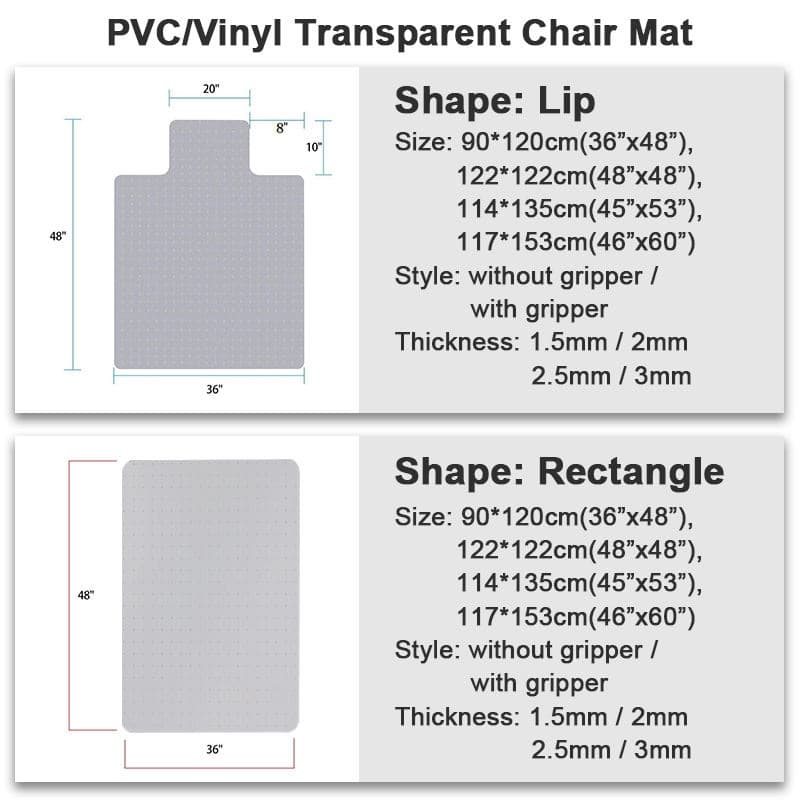
From above, a chair mat for carpet and a chair mat for hard floors look the same: a sheet of clear plastic under a desk chair. Turn them over and they're different products. One is covered in small pins. The other is smooth.
That one detail is where most chair mat orders go wrong, especially when an office has carpet in the open-plan area and hard flooring in the private offices. This guide covers how to choose between the two, and how to order both without the wrong mats ending up on the wrong floors.
The short answer
Choose a chair mat for carpet with a gripping underside (anti-slip pins) so it holds in the pile, and a chair mat for hard floors with a smooth, non-marking underside so it lies flat without scratching. On thicker carpet, go thicker. Then label each mat by floor type, because the two look identical from the top.
What a chair mat for carpet needs
Carpet moves. Every time a chair rolls, the pile compresses and pushes the mat a little. A clear chair mat for carpet stops that with a gripping underside: hundreds of short pins that sink into the pile and anchor it.
The second requirement is stiffness. On soft, cushioned carpet a thin mat flexes under the chair's castors, and a mat that keeps flexing in the same spot will eventually crack. Buyer's guides such as MyBinding's chair mat guide put it simply: the thicker the carpet, the thicker the mat. They also note that most office carpet is low pile, which is the easy case.
- Low-pile office carpet: a pinned mat at standard thickness usually does the job.
- Thicker or cushioned carpet: step up in thickness so the mat doesn't flex. MatCore's clear mats come in 1.5mm, 2mm, 2.5mm and 3mm, or custom.
- Not sure of the pile? A quick check from the same guide: straighten a paperclip, push it down through the carpet to the subfloor, and measure how far it went in.
What a chair mat for hard floors needs
Hardwood, laminate, tile and vinyl need the opposite. Pins on a hard floor do two bad things: they lift the mat so it rocks, and they press into the finish, which on wood means marks that show when the mat is moved. As the MyBinding guide says, on hard floors you skip the spikes because they'll only damage the floor.
A chair mat for hard floors uses a smooth, non-marking underside instead, often with a fine micro-dot or grid texture that holds it in place without scratching. It doesn't need to be thick. The floor is already firm, and a thick mat on a hard floor is just a bigger edge to trip over.
What happens when you use the wrong one
This is the part the product listings don't show you, and it's why we'd rather spend a few minutes confirming floor types before an order than deal with complaints after it.
- Carpet mat on hardwood: the pins dig into the finish under the weight of the chair. You won't see it until the mat is lifted, and by then the whole footprint is marked.
- Hard-floor mat on carpet: the smooth underside has nothing to grip. The mat creeps across the room, its edges lift, and on cushioned carpet it flexes until it cracks.
- Too thin on thick carpet: the mat dishes under the castors, so the chair always rolls back into the dip.
- Too thick on a hard floor: a raised edge in a walkway, with no benefit in return.
Shape and size: lipped, rectangular or round
Floor type decides the underside. The desk decides the shape.
- Lipped (T-shape): a tab extends under the desk to protect the floor where your feet and the chair go furthest in. On our 36″×48″ lipped mat the lip is roughly 20″ wide and 10″ deep.
- Rectangular: the simplest option for open desks and for chairs that move along a long workstation.
- Round: 100, 120 or 150cm, for round desks or gaming setups where the chair swivels a full circle.
- Standard sizes: 36″×48″, 48″×60″ and 48″×72″ cover most desk setups, with others such as 90×120cm, 122×122cm and 117×153cm also available. Custom die-cut outlines start at around 200 pieces.
Ordering for an office with both floor types
Here's where B2B orders differ from buying one mat for a home office. A dealer fitting out a building, or a facilities team replacing mats across several floors, usually needs both types at once. That's fine, as long as the two never get mixed up.
Start with a floor survey: count the workstations on carpet and on hard flooring separately, and note any carpet that's noticeably thicker than the rest. Order them as separate lines, by floor type and size. Ask for the cartons to be marked by floor type too. A clear mat with pins and a clear mat without them look the same in a stack, and the person installing them on a Saturday morning won't be turning each one over.
- Separate line items: floor type × shape × size × thickness.
- Carton labels that say carpet or hard floor, not just a product code.
- Allow time to flatten: standard-thickness mats ship rolled and flatten within 24–48 hours at room temperature. Thicker mats (4mm and up) ship flat-packed.
- Plan installation after that window, not on the day of delivery.
Material and safety basics
MatCore's clear office chair mats are made from PVC or polycarbonate in a low-odour, phthalate-free formulation that resists yellowing over time, so a mat that looks clear on day one still looks clear on a light-coloured floor a year later. Reinforced or bevelled edges help chairs roll on and off and reduce trips at the mat's edge.
If the mat is for a gaming setup or a branded range rather than an office, that's a different product. We compared the two in office vs gaming chair mats.
FAQ
Can I use a carpet chair mat on a hard floor? No. The pins on a carpet mat can mark hardwood and other finishes and make the mat rock. Use a hard-floor mat with a smooth, non-marking underside.
Can a hard-floor chair mat be used on carpet? It isn't recommended. Without pins it slides on the pile, and on thicker carpet it flexes and can crack.
What thickness of chair mat do I need for carpet? Thicker carpet needs a thicker mat. MatCore clear mats come in 1.5mm, 2mm, 2.5mm and 3mm, or custom; tell us the carpet type and we'll recommend one.
How long does a rolled chair mat take to lie flat? Standard-thickness mats typically flatten within 24–48 hours at room temperature. Mats 4mm and thicker ship flat-packed.
Do you supply mixed orders for both floor types? Yes. See the chair mat range, or send us your floor survey with workstation counts and we'll quote both types.
This article is general industry guidance. For advice on a specific project, contact our team.
Related products