Bar Mats · 6 min read · October 5, 2026
Rubber, PVC or Sublimation Bar Mats? How the Material Changes What You Get
A moulded rubber or PVC bar mat drains spills through a raised grid. A sublimation bar mat soaks them into a polyester face. That one difference shapes everything else.
Ask for custom bar mats and you'll be offered three materials: rubber, PVC and a sublimation-printed fabric mat. Suppliers usually present them as price tiers. They aren't. They handle a spilled pint in two completely different ways, and that decides where each one belongs.
Our custom bar mats buyer's guide covers sizing, artwork files and the moulded-versus-printed decision. This piece is about the material underneath that decision, and what it means for your venues, your washing routine and your order size.
The short answer
Choose moulded rubber or PVC bar mats for busy, wet service stations: the raised grid and edges hold spills and the mat rinses clean. Choose sublimation bar mats when the artwork is full-colour or photographic, the order is smaller, or you want blanks to print yourself. The absorbent polyester face soaks up drips instead of draining them.
Two ways to deal with a spill
Picture the last hour of a Saturday shift. Drinks go down fast, glasses get knocked, the bartender wipes and pours again.
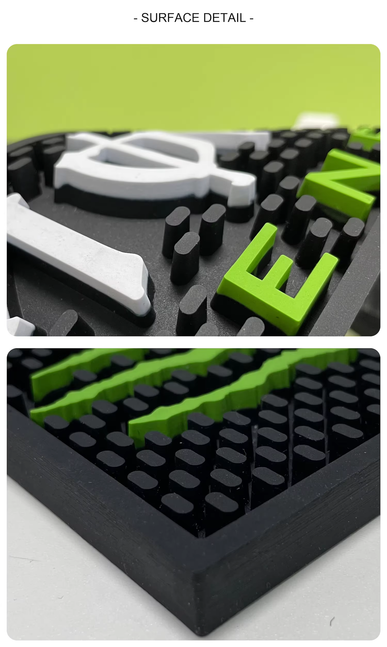
A moulded rubber or PVC bar mat handles that with geometry. Raised pins lift glasses above the liquid, drainage channels let it run, and raised edges stop it reaching the bar top. The mat holds the spill on its surface until someone tips it into the sink.
A sublimation bar mat handles it with absorption. Its 400gsm polyester face takes the drips into the fabric, and the 1900gsm nitrile rubber backing underneath resists seepage, so the liquid stays in the mat and off the counter. There's no puddle for a glass to sit in, which looks tidier at a taproom counter. But a fabric face has a limit, and a flooded cocktail station will reach it.
Neither is better in general. They're built for different volumes.
Rubber vs PVC: the two moulded options
Rubber and PVC bar mats are both moulded, both carry raised logos, and in MatCore's range both are food-safe and resistant to spirits and beer. The differences are mostly about feel and detail.
Industry guides such as this explainer on PVC bar mats describe PVC as the most common material for branded bar mats, because it moulds crisp, raised logo detail in bright colours. Rubber is heavier and more flexible, so it sits flatter and stays put, but fine detail is harder to reproduce in it.
- Pick PVC when the logo has several colours or sharp lines that need to stand out in relief.
- Pick rubber when weight and grip matter more than detail, for example on a sloped or shiny bar top.
- Either way, a moulded logo needs tooling, so the mould is a one-off cost you spread across the order.
- Ask which construction suits your washing routine. Many rubber and PVC mats can be washed by hand or in a commercial dishwasher, but not every build suits both.
How sublimation bar mats are printed
Dye-sublimation only works on polyester, which is why these mats have a fabric face rather than a rubber one. Your artwork is printed onto transfer paper, then heat-pressed into the polyester at 180°C (356°F) for about 60 seconds. The ink turns to gas and bonds inside the fibres instead of sitting on top as a layer.
Two consequences for buyers. There's no colour limit, so gradients, photographs and full label artwork print exactly as designed, edge to edge. And because the colour is in the fibre, there's no printed film on the surface to scratch or peel.
What you give up is the 3D effect. A sublimation mat is flat and soft (3mm thick), so your logo is printed, not raised.
Order size: where sublimation changes the maths
Moulded bar mats carry a tooling cost. That's fine for a beverage brand ordering thousands of mats for a national rollout. It's a lot to absorb for a single bar, a small brewery launch or a seasonal promotion.
Sublimation has no mould. MatCore's sublimation printed bar mat starts at 50 pieces, and every mat in the run can carry the same artwork without any setup tooling. For a taproom that wants a mat for each new release, or a brand testing a design before committing to a moulded run, that's the practical route.
As a rule of thumb: high volume and a simple logo point to moulded; small runs or complex artwork point to sublimation.
Blanks for print shops and decorators
If you run your own heat press, you don't need us to print at all. The same polyester-on-nitrile construction is available as blank mats, ready for your own sublimation. Decorators and print-on-demand sellers use them to offer custom bar mats in single units or short runs. The same construction also works as a counter mat or a door mat, so one blank stock can cover several products.
If that's your business, our guide to choosing sublimation blank mats goes deeper on blanks.
Quick decision guide
- Busy cocktail or beer station, heavy spills, glasswasher cleaning: moulded rubber or PVC.
- Multi-colour raised logo that must look sharp: PVC.
- Heavy, grippy mat for a smooth or uneven bar top: rubber.
- Photo, gradient or full-colour label artwork: sublimation.
- Small run, frequent design changes or a test batch: sublimation (from 50 pieces).
- You print in-house: sublimation blanks.
FAQ
What is the difference between rubber and PVC bar mats? Both are moulded with raised edges, drainage channels and raised logos. PVC reproduces crisp, multi-colour logo detail; rubber is heavier and more flexible, so it lies flatter and grips well.
Are sublimation bar mats absorbent? Yes. The polyester face absorbs drips, and the nitrile rubber backing resists seepage so liquid doesn't reach the bar top.
Can a sublimation bar mat have unlimited colours? Yes. Dye-sublimation prints full-colour artwork, including photos and gradients, with no colour limit.
What are the MOQ and lead time? Sublimation bar mats start at 50 pieces; MOQ for moulded mats depends on size and build. Stock items typically ship in 7–15 days and custom orders in 20–30 days. Browse the bar mat range or tell us about your venues and we'll recommend a material.
This article is general industry guidance. For advice on a specific project, contact our team.
Related products