
Motorcycle Mats · 7 min de lecture · 30 septembre 2026
What Makes a Motorcycle Pit Mat Resistant to Oil and Grease?
"Oil resistant" on a pit mat spec sheet usually describes one layer. Real resistance comes from how the top, the backing and the print handle oil, fuel and brake fluid together.
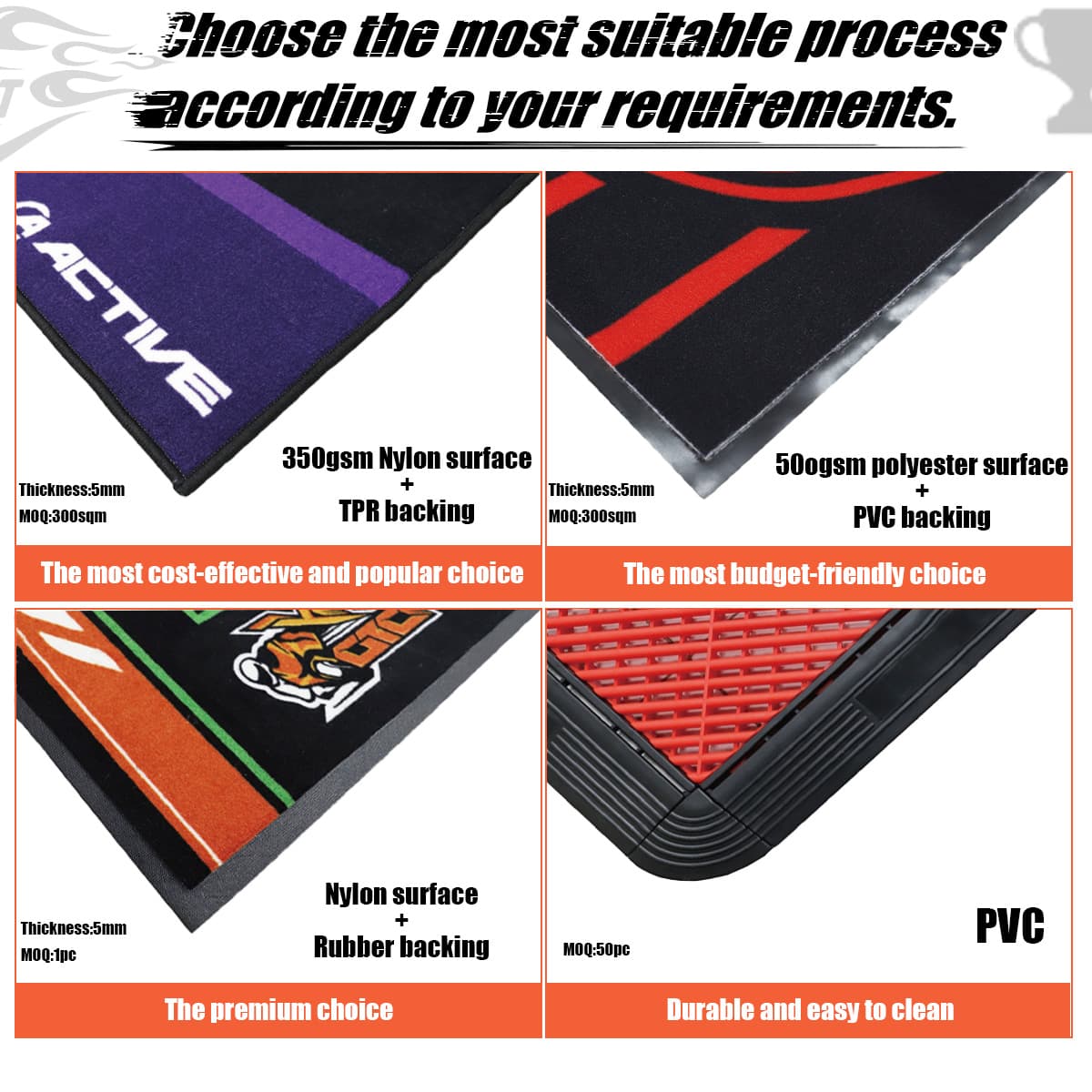
Every motorcycle pit mat listing says "oil resistant." Very few say what that means. And when you're ordering a few hundred mats for dealer showrooms or a workshop chain, that gap turns into returns: mats that stain after the first chain lube, backings that go soft and sticky, printed logos that fade where the degreaser hits them.
Oil resistance isn't one property. It's how three parts of the mat behave together when oil, fuel and grease land on them. Once you know which part does which job, writing a spec (and checking a sample) gets a lot easier.
The short answer: it's a two-layer job
An oil-resistant motorcycle pit mat has an absorbent top layer that catches and holds drips so they don't spread, bonded to an impermeable backing that stops fluid reaching the floor. The top handles the spill. The backing protects the floor. If either layer fails, the mat fails, however good the other one is.
- Top layer: catches oil, fuel and coolant, holds it in place, and releases it again when washed.
- Backing: blocks seepage to the floor and has to keep its grip and shape after repeated fluid contact.
- Print: the logo or graphic has to survive both the spills and the cleaning that follows.
Motorsport already wrote the rule
Racing bodies worked this out years ago. Under the FIM Environmental Code, riders must use an environmental mat wherever a motorcycle is serviced in the paddock, and under fuel containers and generators too (MXGP's summary of the FIM policy). The code describes that mat as an absorbent upper part over an impermeable lower part.
That's the same logic you want in a dealership service bay or a home garage. A mat that only absorbs lets oil soak straight through to the concrete. A mat that only repels sends drips rolling off the edge. The combination is what actually contains a spill.
One caution if you sell into racing: a mat built on the same idea isn't automatically approved for a specific series. If your buyers need FIM or AMA compliance, check that series' current rules before you advertise it.
The top layer: absorb, hold, release
Picture a drip from a leaky fork seal. On a smooth vinyl surface it beads, runs and ends up as a streak under the next boot that steps in it. On a fibre surface it wicks into the pile and stays roughly where it landed.
MatCore pit mats use a nylon top layer, with absorbent top-layer options depending on how the mat will be used. Nylon is a practical choice for this because it holds printed colour well and stands up to scrubbing. But the part buyers forget is release. A good top layer lets the oil go again with detergent and water. A poor one keeps a permanent dark patch, which on a dealer-branded mat means the logo looks dirty long before the mat is worn out.
Match the absorbency to the job:
- Workshop and service bays: prioritise absorbency. Drips are daily, and containment matters more than looks.
- Showroom and display: a denser, cleaner-looking surface with enough absorbency for the odd drip, since the print is the point.
- Home garages sold through retail: somewhere in between. The bike leaks occasionally and the owner wants it to look good in photos.
The backing: where "oil resistant" is usually decided
Most oil damage on a pit mat starts underneath, not on top. The backing sits in contact with whatever makes it through the pile, sometimes for weeks between cleanings.
MatCore builds pit mats on rubber or TPR backings, chosen for grip plus UV stability and fade resistance. Here's the general materials picture, and why you should ask any supplier which compound they use rather than accepting "rubber back":
- Rubber is a family, not one material. Natural rubber tends to swell and soften with prolonged petroleum-oil contact, while nitrile (NBR) is the rubber the industry turns to when oil resistance is the main requirement.
- TPR (thermoplastic rubber) varies a lot by grade. Some grades handle oil well, others don't, so ask for the grade or a drip-test result rather than assuming.
- PVC backings are waterproof and cheap, but plasticised PVC can stiffen or crack over time as oils and solvents draw out the plasticiser.
- Whatever the compound, look at the bond between top and backing. Fluid that gets into a weak bond causes delamination at the edges first.
Fuel, brake fluid and degreaser are harder than oil
Engine oil is the easy case. The fluids that really test a pit mat are the ones mechanics also spill:
- Petrol evaporates fast but is a stronger solvent than oil, so repeated splashes can attack weaker backings and some print inks.
- Brake fluid (glycol-based DOT 3, 4 and 5.1) is known for damaging paint and some plastics. Wipe it up quickly on any mat.
- Chain lube and bead grease are sticky and sit on the surface, which is exactly where an absorbent top helps.
- Degreasers and strong solvent cleaners often do more harm to the print than the spill did. That's a cleaning problem, and it belongs in your care instructions.
Why the printed logo is part of oil resistance
For B2B buyers the mat is usually branded: a dealer name, a club crest, an accessory brand. So "resistant" has to include the graphic. If the colours bleed or fade every time the mat is scrubbed, it's failed as a branded product even if the floor underneath stayed clean.
MatCore prints dealer, club and brand graphics to your artwork, on constructions picked for UV stability and fade resistance so graphics hold up under workshop lighting and outdoor sun. Before sign-off you get a free digital proof. Check the proof for colour, but also think about where the drips will land: a white logo right under the engine is going to show every mark.
How to test a motorcycle pit mat sample before a bulk order
You don't need a lab. A simple drip test on a sample tells you most of what you need, and it takes an afternoon:
- Drip used engine oil, chain lube and a little fuel on the print and on a plain area. Leave them for 24 hours.
- Flip the sample over. Any stain or damp patch on the back means fluid is getting through.
- Clean it the way your customers will: mild detergent, rinse, air dry. Note what's left.
- Press the backing with a thumbnail where the oil sat. Soft, tacky or swollen backing is a warning sign.
- Check the edges for lifting between top layer and backing.
- Repeat the cycle a few times if the mats are going into daily workshop use. One clean result doesn't prove much.
What to put in your spec when you order
"Oil-resistant pit mat, black, bulk" gets you whatever the supplier had in mind. A spec that names the use and the fluids gets you a mat built for them. Tell your supplier:
- Where the mat goes: service bay, showroom display, retail home garage or race paddock.
- Which fluids it will see most, and how it will be cleaned.
- Backing material by name, and whether you want absorbent top-layer options.
- Bike models or target dimensions. MatCore sizes mats to the models you specify; our size guide covers how to work that out.
- Floor type (sealed concrete, epoxy, tile), since it affects which backing grips best. There's more on that in how to stop a pit mat slipping.
FAQ
Is an oil-resistant pit mat the same as a waterproof mat? No. A waterproof backing stops fluid reaching the floor, but oil resistance also means the backing doesn't soften from oil and the top layer can be cleaned without permanent staining.
Can pit mats be washed? Yes, but gently. Mild detergent and water, then air dry fully before parking the bike on it again. Skip harsh solvent cleaners, which can dull the print.
What's the difference between a pit mat and a motorcycle rug? Usually just the name. See motorcycle rug vs pit mat.
What are the lead time and MOQ? Stock designs typically ship in 7–15 days and custom orders in 20–30 days. MOQ depends on size and format, and we confirm it in the quotation. Start with the Motorcycle Parking & Display Mat, or send us your models and use case for a quote.
Cet article est un guide général du secteur. Pour un conseil sur un projet précis, contactez notre équipe.
Produits associés