Door Mats · 6 min read · September 25, 2026
What Makes an Entrance Mat "Commercial Grade"? A Buyer's Checklist
"Commercial grade" isn't a certified standard. It's a label. Here's what should sit behind it on a logo entrance mat, and what to ask a supplier to prove.
A commercial grade entrance mat is one built to take heavy foot traffic, trap dirt and water, stay put, and survive repeated cleaning without losing its shape or its print. In practice that means a nylon face on a rubber backing, a stated wash life, and an inspection process you can ask about. "Commercial grade" itself isn't a certified standard, so check the construction, not the label.
Why the label alone tells you nothing
Search any marketplace for commercial entrance mats and you'll find "commercial grade" on mats that cost a few dollars and mats that cost fifty. Nobody certifies it. So when a retail chain, hotel group or rental company buys logo entrance mats in volume, the useful question isn't "is it commercial grade?" but "what is it made of, and how do you know it will last?" The next four sections are the answers you should expect.
1. Commercial grade face yarn: nylon vs. polypropylene
Nylon is the benchmark for commercial entrance mats. It traps dirt, absorbs water and recovers after being walked on, and it takes printed logos well. Our store-branded logo entrance mats use a Nylon 66 surface for that reason.
Polypropylene (PP) is cheaper. On a PVC backing it makes a sensible value mat for budget-driven programs. It just won't match nylon's wash life or feel. Neither choice is wrong. The problem is paying for nylon and receiving PP, so ask for the face material in writing.
2. A commercial grade backing: rubber, and how it's attached
The backing is what keeps a mat flat and still when two hundred people a day walk across it. Commercial entrance mats use rubber, either standard or industrial grade. On a nylon-and-rubber mat the rubber is vulcanized, which means bonded to the face under heat and pressure, so the two layers act as one piece instead of peeling apart after a few washes. Cheaper home mats often use a latex or foamed backing instead, which is fine at a front door and a weak point in a busy lobby.
Ask the supplier which backing and which bonding process is used. A clear answer here tells you more than any adjective on the product page.
3. Wash life: the number to ask for
If your mats go into a rental or laundering program, wash life is the spec that matters most. Our nylon-and-rubber rental entrance mats are machine-washable 300+ times. A solution-dyed polyester and rubber option is also machine-washable and colour-fast, because the colour is added when the fibre itself is made, not printed on afterwards.
If a supplier can't give you any wash figure at all, it isn't a commercial grade mat for rental use. Assume it was built for a front porch, not a laundering route.
4. Water and dirt holding
An entrance mat's real job is stopping rain and grit before they reach the floor, which is also where slip claims start. Buyers in the US often use a water-holding figure as a benchmark. Ultimate Mats, for example, describes commercial entrance mats that hold up to 1.5 gallons of water per square yard. Whatever figure you work to, test a sample the way you'll use it: pour water on it, walk it in, and check it doesn't leak at the edges or slide.
Logo quality on a commercial entrance mat
A logo entrance mat has two jobs, and the branding half fails first when the print is cheap. Commercial logo mats are printed with CMYK inkjet or ChromoJet systems, which inject dye into the pile rather than sitting on the surface. We work to Pantone references and produce a pre-production sample for approval before bulk printing. For a multi-site brand that's the step that keeps the red in Manchester the same red as in Chicago.
How mats are checked before they ship
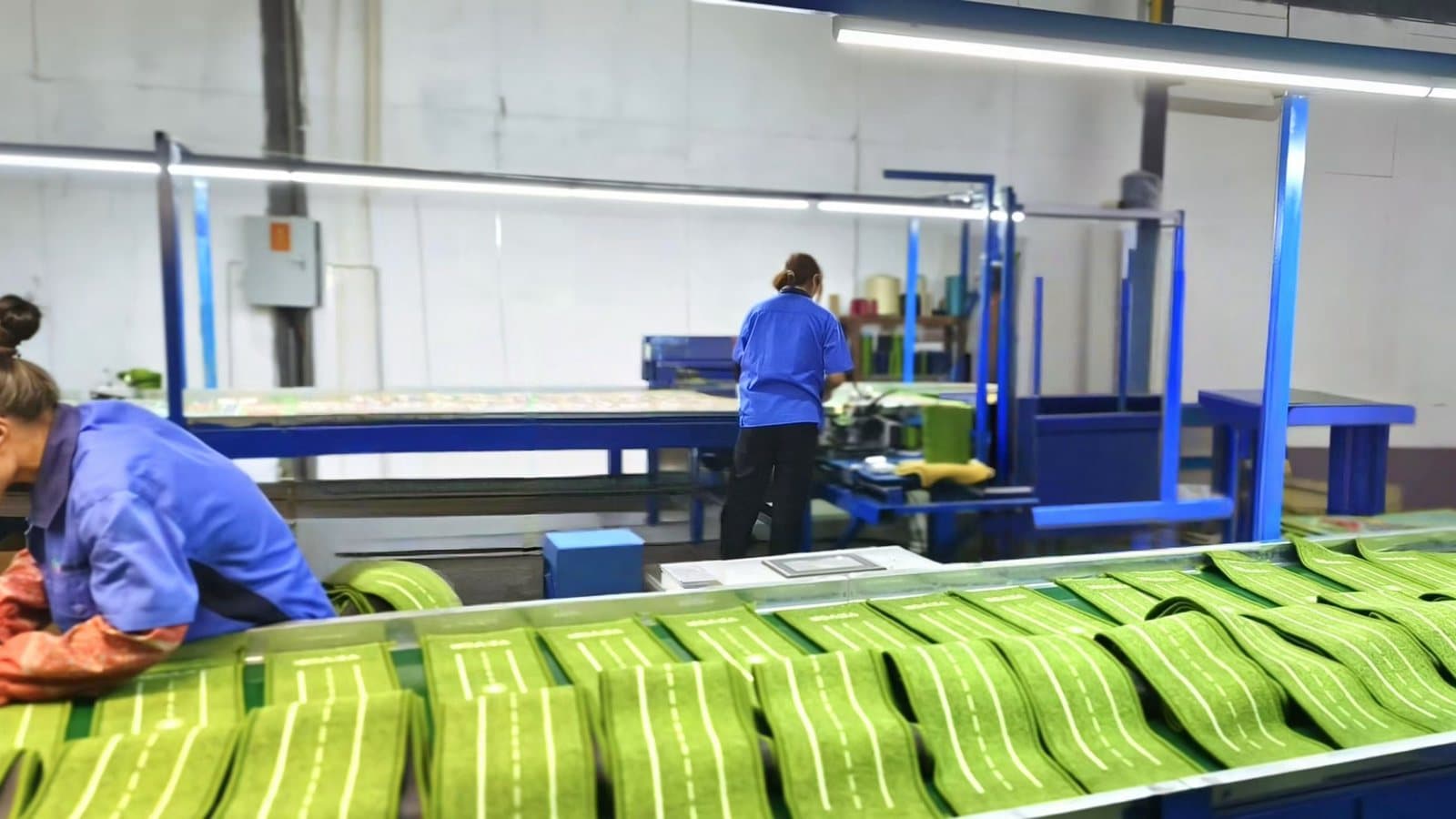
This is the part buyers rarely ask about, and it's where finished quality is decided. A typical tufted entrance mat runs through these production steps:
- Tufting: yarn is tufted into the base cloth.
- Vulcanizing or backing: the rubber backing is bonded to the face.
- Printing: logo or artwork is printed into the pile.
- Cutting and overlocking: the mat is cut to size and the edges are finished.
- Needle detecting: every mat passes through a metal detector to catch any broken needle left in the pile.
- Inspection and packing: loose threads are trimmed, loose fibres are blown off, and each mat gets a final visual check before packing.
Our quality checks run in three stages: material tests, anti-slip and performance checks, and a final visual inspection. If you're buying for a regulated market, ask which test reports can be supplied for your specific construction before you place the order, not after.
The short checklist
- Face yarn named in writing (nylon, Nylon 66 or PP).
- Backing type and how it's bonded.
- A wash-life figure if the mats will be laundered.
- Printing method and Pantone approval on a pre-production sample.
- Edge finish that won't curl or fray.
- Needle detection and a final inspection before packing.
If a mat ticks all six, call it commercial grade. Browse custom logo entrance mats, the commercial rental entrance mat in nylon and rubber, or the full door mat range. For the branding side, see how long printing lasts on a custom logo floor mat.
This article is general industry guidance. For advice on a specific project, contact our team.