Sports Mats · 5 min read · October 20, 2026
Putting Mats for Indoor Golf Centres and Simulator Studios: How to Specify Them
In an indoor golf centre, the putting mat is the surface customers judge the venue on after the screen. Here's how venue owners and simulator studios choose putting mat speed and construction, plan the layout, and order branded mats that match across every bay.
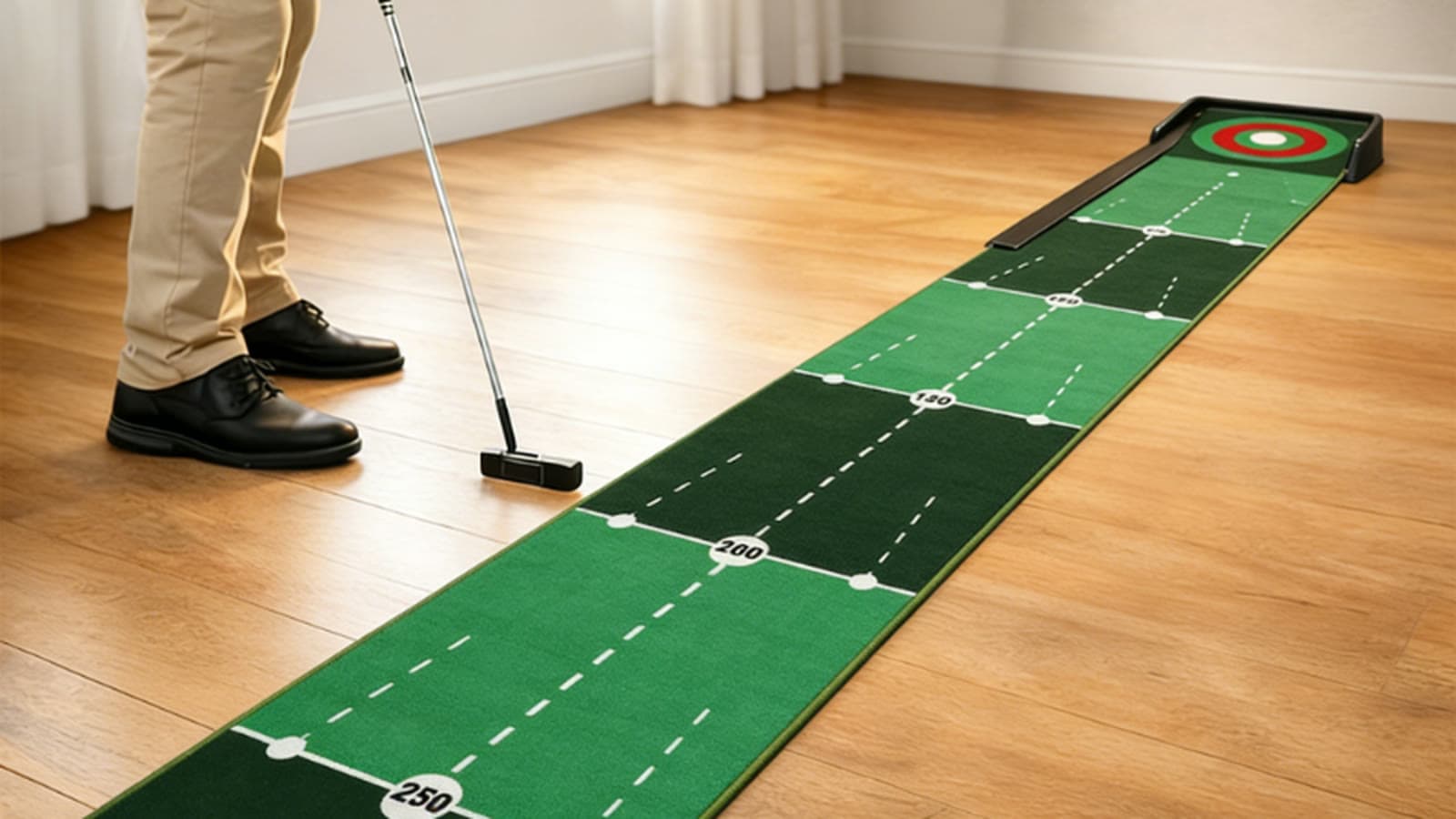
A customer hits a good drive on the simulator, walks over to the putting area and rolls a six-footer. If the ball skids, hops or dies halfway, the session ends on a bad note, however good the screen looked. In an indoor golf centre the putting surface gets used by every customer, every hour.
This guide is for indoor golf centre owners, simulator studios and the fit-out companies that build them. It covers how to choose a putting mat's speed and construction, how to plan the putting area and what to put in an order for several bays.
The short answer
Choose the putting mat by speed first: a polyester face on a non-woven backing rolls fastest, polyester on TPR sits in the middle, and nylon on TPR rolls slower and feels more premium. Then specify the size per bay, printed lines, targets and branding, and order every bay in the same construction so the roll is consistent across the venue.
Speed comes from the construction
Putting mat speed is set by the face fibre, the pile weight and the backing. Different materials give different ball speeds:
Polyester on a non-woven backing (a dotted base) is the fastest roll. Our MC-SJR has a 120gsm polyester face on an 800gsm non-woven backing, 5mm thick and printed by sublimation. It's the economy option and suits fast practice greens.
Polyester on TPR sits in the middle. The MC-2270PT is a 270gsm polyester face on a 900gsm TPR backing, 5mm, with no limit on print colours: a fast, cost-effective mat.
Nylon on TPR rolls slowest because of the heavier pile, and it looks and feels the most upmarket. The MC-2350PT is a 350gsm nylon face on the same 900gsm TPR backing, 5mm, with up to 12-colour CMYK printing: a medium roll with the most premium feel.
Matching speed to the venue
- Simulator studios where putting happens on the simulator itself: choose the mat the simulator's putting is calibrated for, and keep the same construction in every bay.
- Practice-focused centres and coaching studios: a medium-speed polyester-on-TPR mat gives a steady, readable roll for drills.
- Social and entertainment venues: speed matters less than durability and looks. A branded mat with printed targets and the venue's colours adds to the experience.
- Venues with mixed floors: the floor under the mat changes the roll. A level, hard subfloor gives the most consistent speed; see why the floor underneath changes the speed.
Planning the putting area
Indoor golf customers want a putt long enough to mean something. Plan the length around the space, not around a stock size: putting mats are made in custom lengths and widths, so a mat can run the full depth of a bay or fill a dedicated putting corner.
Lines and targets can be printed onto the face: alignment lines, distance markers and target circles help with drills and give casual players something to aim at. For a social venue, printed games and the venue's logo turn the putting area into part of the brand.
Branding and consistency across bays
- Use one construction for every bay. Customers notice when the roll changes from one bay to the next.
- Put the logo where the ball doesn't roll: at the ends or the edges of the mat.
- Send Pantone references for brand colours, and confirm the layout on a free digital proof before production.
- Order a few spare mats in the same construction, so a worn mat can be replaced without changing the roll.
Being honest with customers about the roll
A putting mat is tuned to feel close to a real green, but a practice mat and an outdoor green will never behave identically. Venues that say so up front get fewer complaints. For more on what makes one mat roll better than another, see what makes a golf putting mat better and our putting mat thickness guide.
How to order
Send the number of bays, the size of each putting area, the speed you want, and any lines, targets or branding. MOQ and lead time are confirmed in the quote. See the golf putting practice mat, the sports mat range, or send us your venue plan.
FAQ
What is the best putting mat for an indoor golf centre? The best putting mat for an indoor golf centre is one construction used in every bay, chosen for the speed the venue wants: polyester on non-woven for a fast roll, polyester on TPR for medium, nylon on TPR for a slower, premium roll.
Can putting mats be made to the size of a simulator bay? Yes. Putting mats are made in custom lengths and widths, so a mat can fit a bay or a dedicated putting area.
Can a putting mat have our logo and printed targets? Yes. Putting mats can be printed with alignment lines, targets and branding, and the layout is confirmed on a free digital proof.
Does a putting mat roll exactly like a real green? No. A putting mat is tuned to feel close to a real green, but a practice mat and an outdoor green will never behave identically.
This article is general industry guidance. For advice on a specific project, contact our team.
Related products