
Carpet Tiles · 6 min read · October 16, 2026
Carpet Tile Sizes and Installation Patterns: Monolithic, Quarter-Turn, Ashlar and Herringbone
The same carpet tile can look like a different floor depending on how it's laid. Here's how carpet tile sizes (50×50, 25×100 planks and 60×60) combine with the four common installation patterns, and what to tell your supplier before you order.
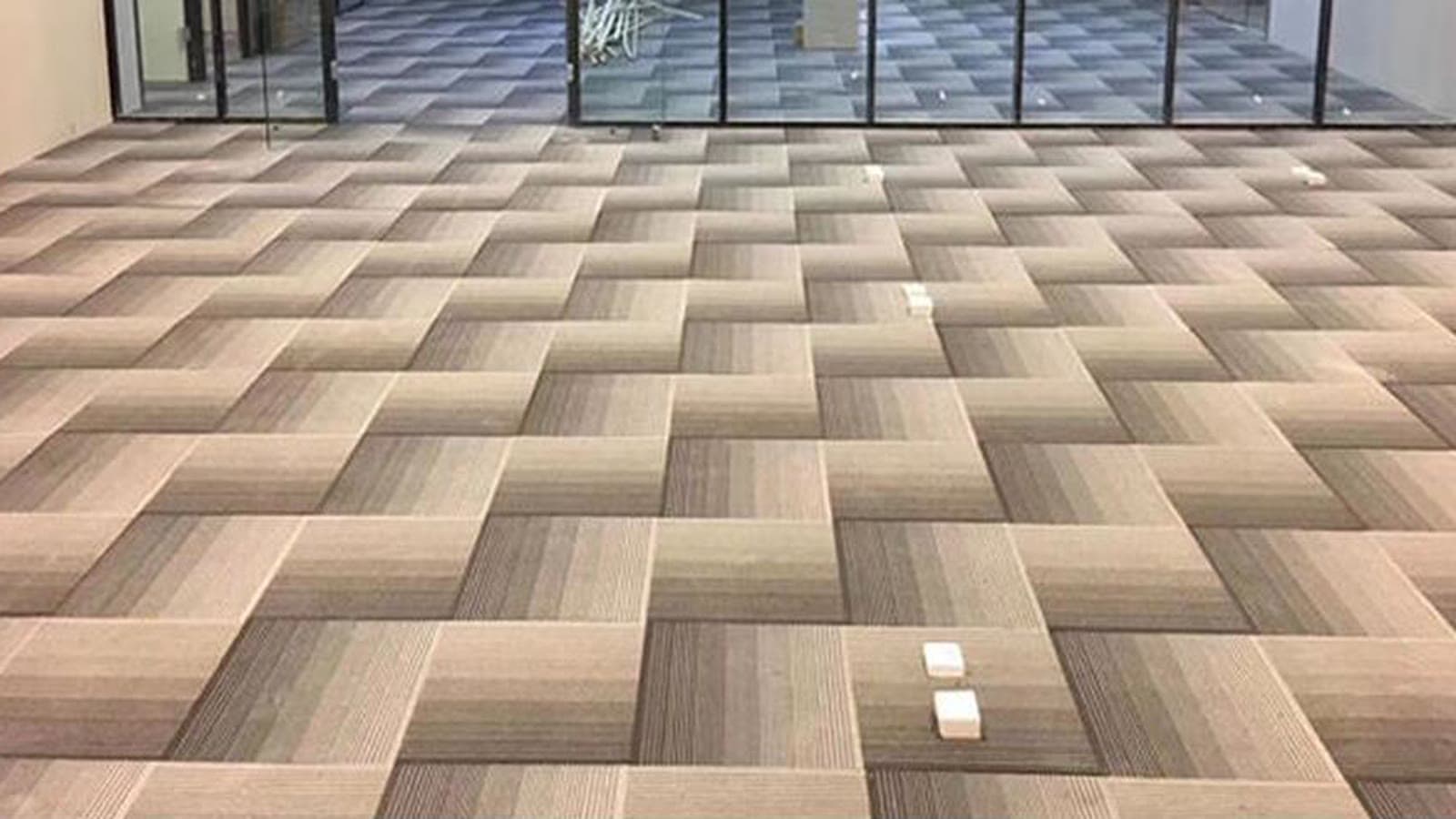
Lay a box of carpet tiles all facing the same way and the office looks like one continuous carpet. Turn every other tile ninety degrees and the same product becomes a checkerboard of light and shade. Nothing about the tile has changed; only the installation pattern has.
This guide is for contractors, fit-out companies and distributors choosing carpet tile sizes and carpet tile patterns for offices, hotels and other commercial spaces. It explains the common sizes, the four main installation patterns and what each one means for ordering.
The short answer
The common carpet tile sizes are 50×50 cm squares, 25×100 cm planks and 60×60 cm (61×61 cm) squares. Squares suit monolithic, quarter-turn and ashlar patterns; planks also open up herringbone and brick layouts. Choose the pattern before you order, because it affects how directional the design looks and how many spare tiles you need.
Common carpet tile sizes
Most commercial carpet tiles come in three formats:
- 50×50 cm squares: the standard format for offices and the easiest to lay, replace and store.
- 25×100 cm planks: long, narrow tiles that make herringbone, brick and ashlar layouts possible and visually lengthen corridors.
- 60×60 cm (61×61 cm) squares: a larger format; 61×61 cm is the 24-inch equivalent.
- Custom sizes: possible, ideally in multiples of 25 cm, because the production machine width and pattern continuity work in that module.
Monolithic: one continuous carpet
In a monolithic carpet tile pattern, every tile faces the same direction, usually following the arrow on the back. The joins disappear as far as they can, and the floor reads as one continuous carpet. Monolithic is the usual choice for open-plan offices, conference rooms and galleries, where the floor should stay calm.
The catch is that a monolithic floor shows mistakes. A single tile laid the wrong way stands out, so installers need to follow the arrows carefully.
Quarter-turn: a checkerboard of light and shade
In a quarter-turn pattern, each tile is rotated 90 degrees from its neighbour. Because carpet pile reflects light differently depending on its direction, the floor takes on a subtle checkerboard look, also called a parquet or tessellated pattern.
Quarter-turn is forgiving. It hides small shade differences between tiles and makes replacement easier, which is why it's popular in busy areas where tiles will be swapped over the years.
Ashlar and brick: offset rows
In an ashlar pattern, tiles keep the same orientation but each row is offset from the one before, so the joins don't line up. Brick is a similar offset, usually by half a tile. Both break up the grid and suit squares as well as planks, giving a floor more movement than monolithic without the checkerboard effect of quarter-turn.
Herringbone: the plank pattern
Herringbone needs planks. 25×100 cm tiles are laid at angles so they interlock in a zigzag, the same way a parquet floor is laid. It's the most decorative carpet tile pattern and works well in hotel corridors, reception areas and showrooms.
Herringbone also creates the most offcuts at the walls, so plan more spare tiles than you would for a monolithic square layout. Our guide on how many carpet tiles you need for an office floor explains how to calculate spares.
Matching pattern to space
Carpet tiles are used in offices, hotels, airport terminals, shopping centres, libraries, meeting rooms, museums, exhibition and banqueting halls, hospitals, banks and server rooms. As a rule of thumb, monolithic suits large open areas that should feel calm, quarter-turn suits high-traffic areas where tiles get replaced, ashlar suits spaces that need a little movement, and herringbone suits areas where the floor is part of the design.
Whatever the pattern, the big advantage of carpet tiles stays the same: damaged tiles can be replaced individually and spot-cleaned, so keep spare tiles from the same production lot. Our article on carpet tiles vs broadloom over five years explains why that matters for running costs.
What to tell your supplier
Send the floor plan, the tile size, the installation pattern, the face fibre (nylon, polypropylene or polyester) and the backing (PVC, TPE, PE, felt, PU or bitumen). Mention the adhesive you plan to use; PE backings are more demanding about adhesive choice. Our guide on what to check before a bulk carpet tile order covers fibre, backing and paperwork in more detail. See the modular office carpet tile, the full carpet tile range, or send us your project.
FAQ
What are the standard carpet tile sizes? 50×50 cm squares, 25×100 cm planks and 60×60 cm (61×61 cm) squares. Custom sizes are possible, ideally in multiples of 25 cm.
What is a monolithic carpet tile pattern? Every tile faces the same direction, so the floor reads as one continuous carpet.
What is a quarter-turn carpet tile pattern? Each tile is rotated 90 degrees from its neighbour, creating a checkerboard of light and shade that hides small shade differences.
Which carpet tiles can be laid in herringbone? Planks, such as 25×100 cm tiles, are laid at angles to form the herringbone zigzag.
This article is general industry guidance. For advice on a specific project, contact our team.
Related products