
Door Mats · 6 min read · October 8, 2026
Custom Welcome Door Mats: How to Design One That Makes a Lasting First Impression
A welcome mat is read in about two seconds, from standing height, often in the rain. Here's how hotels, shops and mat brands design custom welcome door mats that still look right after a year at the door.
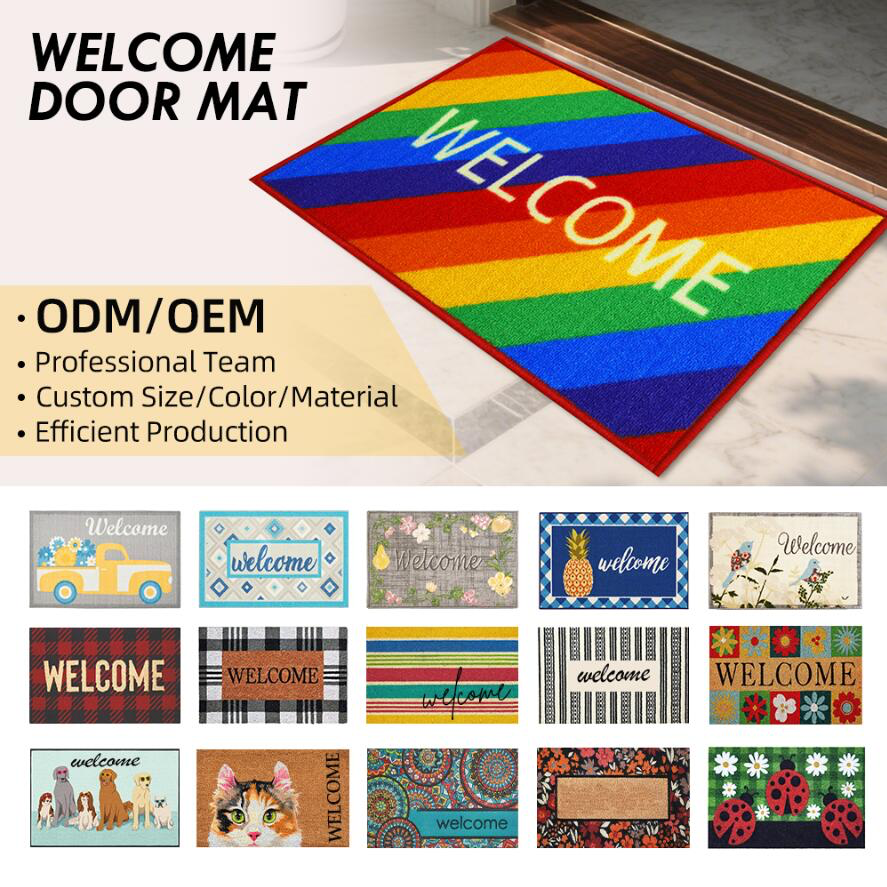
Nobody studies a welcome mat. A guest glances down for a second or two on the way in, usually while doing something else: pulling a door, shaking an umbrella, looking for the reception desk. Whatever your custom welcome door mats say has to land in that glance, from about five feet up.
Most guides to custom welcome mats are written for one homeowner ordering one mat with a family name on it. This one is for businesses buying in quantity: hotels and restaurants, retail chains, property managers, and brands or resellers building a welcome mat line.
The short answer
A custom welcome door mat makes a good first impression when it reads instantly from standing height and still looks clean months later. Keep the message short, make the lettering large with strong contrast, orient it toward people walking in, size the mat to the door, and pick a construction that suits where the mat actually sits.
Design for a two-second read
Start with the words. "Welcome" plus a name or a logo is enough. A second line in small type (opening hours, a tagline, a website) will be walked over unread, and it makes the main message smaller.
Then size the lettering for distance. On a standard entrance-size mat, a single word that runs most of the width reads easily; script fonts and thin serifs at that size blur once the pile softens the edges. Bold, simple letterforms survive printing on a textile surface far better than fine detail does.
Contrast matters more than colour choice. Light lettering on a dark ground (or the reverse) reads in dim entrances and stays legible as the mat collects dirt. Two mid-tones of similar brightness, say a red on a brown, can look fine on screen and disappear on the floor.
Which way should the text face?
Toward the person walking in. A welcome mat outside the door should read correctly for someone approaching from the street or corridor. It sounds obvious, but mats get laid the wrong way round, especially when a printed mat is moved between an outside step and an inside lobby. Inside the door, the rule is the same: it should read for people coming in. People leaving see it upside down, and that's fine.
For artwork with a logo, put the logo where the eye lands first: the upper-middle of the mat as the visitor sees it, not hard against the leading edge where feet scuff it first.
Size the mat to the door, not the artwork
A welcome mat that's narrower than the door frame looks like an afterthought. As a rule of thumb, aim for a mat at least as wide as the opening it serves, and wider for double doors. For an entrance that also has to trap dirt and water, longer is better: a mat that catches two or three steps does more work than one that catches one.
Order the size first, then design. Artwork stretched or cropped to fit a different size late in the process is how logos end up too close to the edge. We make custom sizes and shapes, and if your entrance is unusual, a quick sketch with measurements is enough to start. Our guide to designing door mats that are functional and decorative goes deeper on balancing artwork and performance.
Match the construction to the entrance
The same artwork can be printed on very different mats. Pick by placement and by who's going to clean it.
- Covered porches, shop doorways and interior lobbies: a printed mat with a nylon or polyester face on a latex or TPR backing. This is the classic decorative welcome mat, suited to personalised designs, welcome messages and seasonal themes.
- Busy commercial entrances that need to scrape and absorb: a nylon face on a rubber backing. The nylon absorbs water and holds grit, the rubber keeps the mat in place, and full-colour inkjet printing carries the logo or message.
- Mats on a laundering or rental cycle: a nylon-and-rubber build that can be machine-washed 300+ times, or a solution-dyed polyester and rubber mat that's washable without the colour fading. A lower-cost polypropylene face on PVC is also available where wash life matters less.
- Open, exposed entrances: say so when you order. Indoor and outdoor constructions aren't interchangeable, and our article on why indoor and outdoor door mats use different backings explains why.
Hotels, shops and brands want different things
A hotel usually wants consistency. The same welcome mat at every entrance and every property, matched to brand colours, with spares in storage so a worn mat can be swapped without a visible difference. Ask for colour matching against your brand references and confirm it on a proof.
Retail and franchise stores tend to treat the welcome mat as the first piece of in-store branding. A logo, a short welcome and nothing else. If you're rolling out across dozens of stores, standardise on two or three sizes rather than measuring every doorway to the centimetre; it keeps reorders simple. Our commercial entry welcome mat is built for exactly this kind of use.
Brands and resellers selling welcome mats to consumers need a range, not one mat. A core set of evergreen "Welcome" designs, a seasonal set (Christmas and Halloween designs sell on their own calendar), and a personalisation option. Plan the seasonal artwork early enough to clear production and freight before the season starts.
Keep the first impression past month three
A welcome mat that's faded, curled or caked in grit says the opposite of welcome. Two decisions protect it. First, the construction: choose one rated for where the mat sits, as above. Second, the print: CMYK and inkjet printing on these constructions resist weathering and fading, and darker, busier grounds hide traffic patterns better than pale solids.
Cleaning is simple. Shake, brush or vacuum; printed mats can be washed and air-dried. For how long a printed design really holds up, see how long printing lasts on a logo floor mat.
How ordering works
Send your artwork or logo, the wording, the size and quantity, and where the mats will be used. We confirm the layout with a free digital proof before production, so you see exactly how the lettering sits at full size. Stock items typically ship in 7–15 days; custom orders take 20–30 days.
Browse the door mat range or send us your design brief.
FAQ
What should a custom welcome mat say? Keep it short: "Welcome" plus a business name or logo. Extra lines of small text are rarely read and make the main message smaller.
What size should a welcome door mat be? At least as wide as the door it serves, and wider for double doors. For entrances that need to trap dirt and water, a longer mat that catches more steps works better.
Which material is best for a business welcome mat? For busy commercial entrances, a nylon face on rubber backing. For covered porches and lobbies, a printed nylon or polyester mat on latex or TPR. For rental and laundering programmes, a washable nylon-and-rubber build.
Can you match our brand colours? Yes. Colours are matched to your artwork and confirmed on a free digital proof before production.
This article is general industry guidance. For advice on a specific project, contact our team.