
Blank Mats · 6 min read · October 17, 2026
How to Sublimate Blank Door Mats: Press Settings, Steps and Common Faults
A blank sublimation door mat looks simple to print until the first one comes out pale, patchy or ghosted. Here's a step-by-step process for print shops and POD sellers, the press settings we use on our polyester-on-rubber construction, and how to fix the common faults.
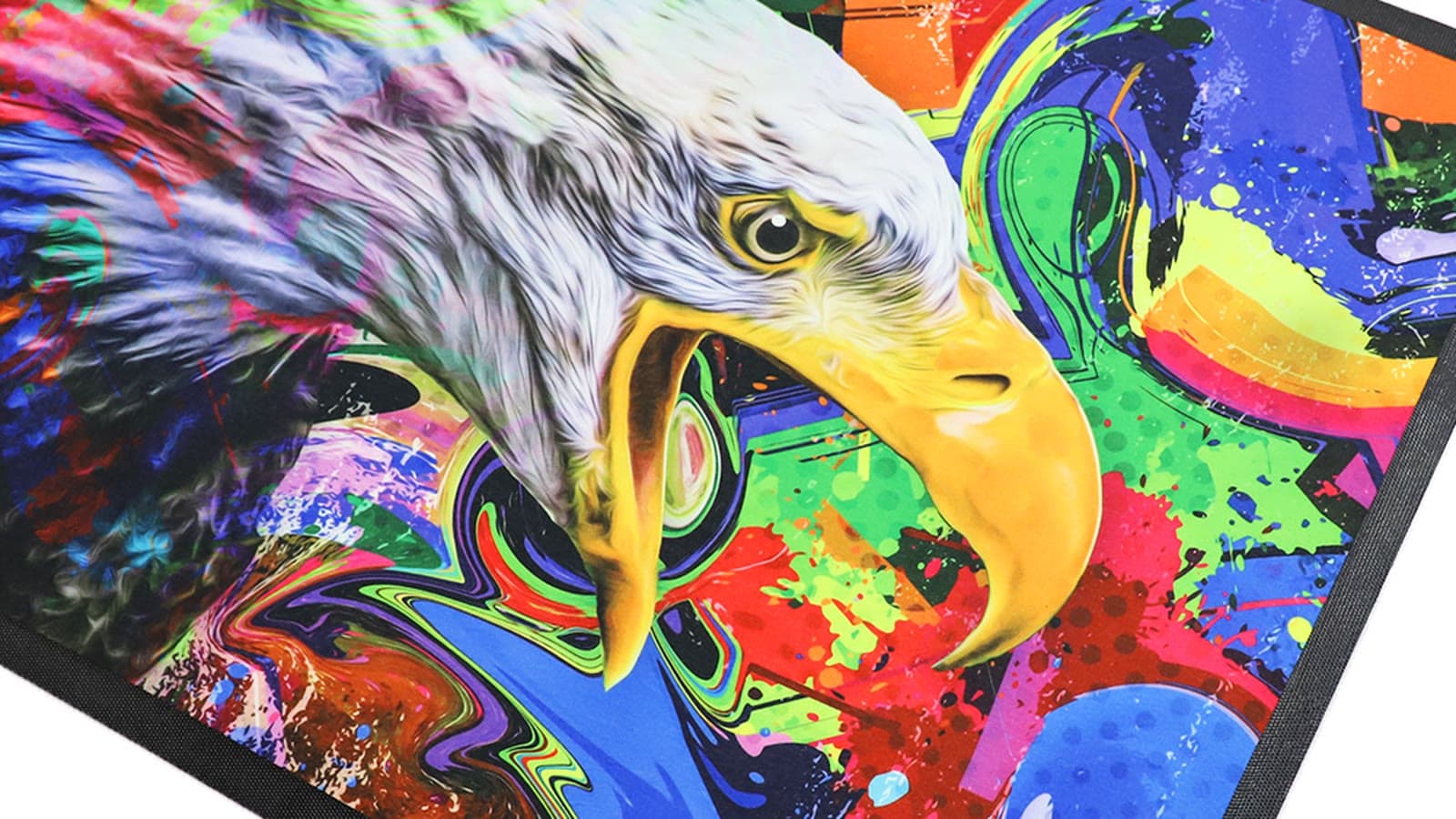
The first blank sublimation door mat out of the press tells you a lot. Colours too pale, a faint double image along one edge, a patch where the ink didn't take. None of that is the printer's fault most of the time. It's the blank, the moisture in it, or how the transfer was held on.
This guide is for print shops, decorators and print-on-demand sellers who sublimate blank door mats in-house. It covers the steps, the press settings we use on our own construction, and the faults that come up most.
The short answer
To sublimate a blank door mat, print the design mirrored on sublimation transfer paper, lint-roll and pre-press the mat, tape the transfer face-down, cover it with protective paper and press. On our polyester-on-nitrile-rubber blanks we press at 180°C (356°F) for about 60 seconds. Peel the paper straight off and let the mat cool flat.
Why the blank door mat matters first
Sublimation ink only bonds to polyester. Under heat the ink turns to gas and moves into the polyester fibres, which is why the colour lasts instead of sitting on top as a layer. A blank sublimation door mat therefore needs a polyester top with a surface that takes ink evenly, on a backing that survives the press.
Our sublimation blank polyester door mat has a white polyester top with a coating tuned for even dye-sublimation colour, on an anti-slip rubber backing, supplied in bulk. Our guide to choosing sublimation blank mats explains what to check in a blank before you buy.
Step-by-step: how to sublimate a blank door mat
This is the process for a single-press door mat:
- Print the design mirrored on sublimation transfer paper with sublimation ink, slightly larger than the print area so the edges are covered.
- Lint-roll the blank door mat to lift fibres and dust, which otherwise leave pale specks.
- Pre-press the mat for a few seconds to drive out moisture and flatten the surface.
- Place the transfer face-down on the mat and fix it with heat-resistant tape so it can't shift when the press opens.
- Cover the transfer with protective paper to catch ink that passes through.
- Press at the setting for your blank; on our polyester-on-rubber construction that is 180°C (356°F) for about 60 seconds.
- Open the press, peel the transfer straight off in one movement, and let the mat cool flat before stacking.
Press settings for blank sublimation door mats
Our sublimation printed mats (a 400gsm polyester surface on a 1900gsm nitrile rubber backing, 3mm thick) are pressed at 180°C (356°F) for about 60 seconds. The same construction also works as a bar mat, counter mat or door mat, so one setting covers the range.
Different blanks from different suppliers need different settings, and presses vary in how evenly they heat. Treat any published setting as a starting point. Run a test mat from each new batch of blanks, check the colour against your proof, and adjust time before temperature.
Common faults and how to fix them
Most failed door mats come from a handful of causes:
- Pale or dull colours: not enough heat or time, or moisture in the mat. Pre-press longer and check the press temperature with a probe.
- Ghosting (a faint double image): the transfer moved when the press opened or when the paper was peeled. Tape every edge and peel straight off.
- Patchy areas: uneven pressure, often because the door mat is thicker than the press was set for. Adjust the pressure for the mat's thickness.
- Pale specks: lint or dust on the surface. Lint-roll before pressing.
- Press lines at the edges: the platen is smaller than the mat. Use a press large enough to cover the whole door mat in one press.
Choosing a press for door mats
A door mat is larger and thicker than a T-shirt, so the press matters. A flat press whose platen covers the whole mat gives the most even result, because one press avoids overlap lines. If your press is smaller than your largest blank, keep that size off your listings or plan for a bigger press before you scale up.
Ordering blank door mats in bulk
If you print in-house, buying blanks in bulk keeps the unit cost down. Blank size and shape, backing type and bulk packaging can be specified, and we confirm the details in the quote. For larger printed rugs, a sublimation blank area rug uses a polyester pile on an anti-slip rubber backing.
If you'd rather not print at all, we can print your artwork for you on the same construction. See the blank mat range, our printed door mats, or send us your blank requirements.
FAQ
What temperature do you sublimate a door mat at? On our polyester-on-nitrile-rubber blanks we press at 180°C (356°F) for about 60 seconds. Other blanks may need different settings, so run a test mat first.
Why is my sublimated door mat pale? A pale door mat is usually caused by too little heat or time, or moisture in the blank. Pre-press the mat and check your press temperature.
What causes ghosting on a sublimation door mat? Ghosting happens when the transfer paper moves during pressing or peeling. Tape the transfer on all edges and peel it straight off.
Can any door mat be sublimated? No. Sublimation ink only bonds to polyester, so the door mat needs a polyester top made for sublimation.
This article is general industry guidance. For advice on a specific project, contact our team.
Related products