Door Mats · 6 min read · October 2, 2026
Custom Door Mat Materials: Which Face and Backing for Which Entrance?
There's no best door mat material, only the right pairing for the doorway. Here's how to match face and backing to six common usage scenarios.
Ask five suppliers for the best material for custom door mats and you'll get five confident answers. Nylon. Polypropylene. Coir. They're all right somewhere and wrong somewhere else, because a door mat is two materials doing two jobs: a face that deals with shoes, and a backing that deals with the floor and the weather.
So the useful question is where the mat will live. Start from the usage scenario and the material choice mostly makes itself.
The short answer
For printed home and retail door mats, use a nylon or polyester face on latex or TPR backing. For outdoor entrances, pair nylon or polyester with rubber. For rental and laundering programs, nylon on rubber is the workhorse. Polypropylene on PVC is the budget option where wash life matters less.
What each face material is good at
- Nylon: absorbs water, holds dirt and takes high-definition print. Soft underfoot, and the face used on MatCore's main rental construction.
- Polyester: a good printing surface for full-colour artwork. In solution-dyed form the colour is in the fibre, which is why it's used for washable, colour-fast mats.
- Polypropylene: the value face. It costs less, and it's the choice when budget matters more than wash life.
- Coir (coconut fibre) is the classic scraper mat and you'll see it in every retail aisle. It isn't part of MatCore's printed range, so if a buyer asks for coir with a photo-quality logo, a printed synthetic face is usually what they actually need.
What each backing is good at
Backing gets less attention than the face and causes more complaints. Briefly:
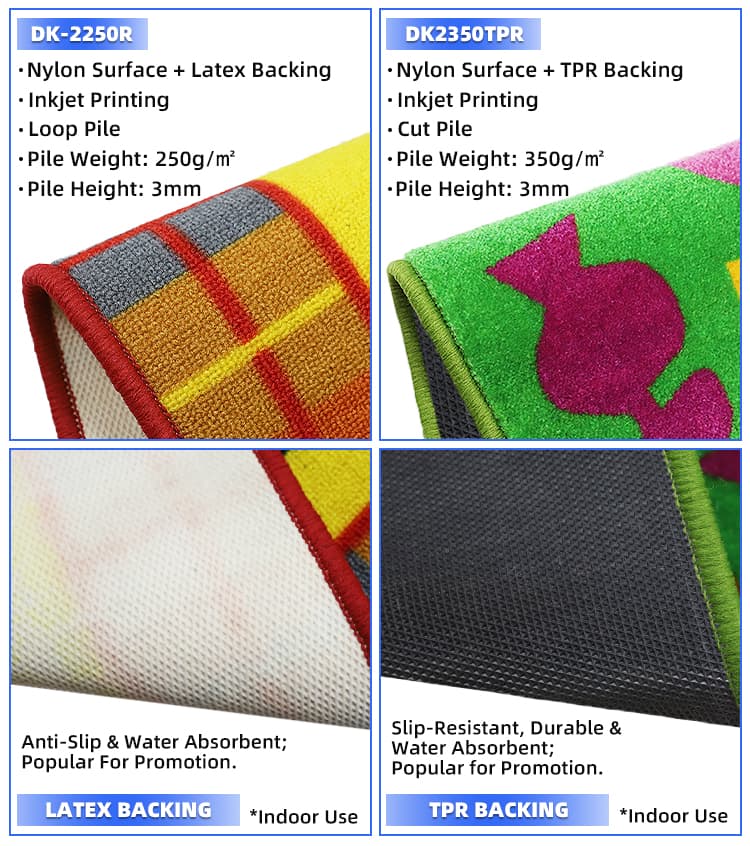
- Latex: light, flexible and economical. A good fit for indoor home and promotional mats.
- TPR: slip-resistant and durable, a step up from latex for printed mats that see more use.
- Rubber: the heaviest and most stable. It's the backing for outdoor entrances and for rental mats that go through industrial washing.
- PVC: paired with polypropylene on value rental mats.
Six usage scenarios, six material pairings
This is the part most material guides leave out. Each scenario below is a real ordering pattern, with the construction that suits it.
- Home retail and gift ranges (welcome messages, personalised designs): nylon or polyester face with latex or TPR backing. Print quality and price point matter most here.
- Seasonal collections such as Christmas and Halloween: the same printed construction. The mat is used for weeks, not years, so put the budget into artwork.
- Hotel, restaurant and shop entrances: a cut-pile nylon face with rubber or TPR backing, printed with the logo. It needs to look good and stay put on hard lobby floors.
- Exposed outdoor doorways: nylon or polyester face on rubber backing, built for continuous outdoor use. Indoor constructions aren't designed to be left outside.
- Mat-rental and laundering services: nylon face on rubber backing, machine-washable 300+ times. Or solution-dyed polyester on rubber where colour fastness through washing is the priority.
- Budget facility programs: polypropylene face with PVC backing, where the lower unit cost outweighs a shorter wash life.
How to choose when two scenarios overlap
Real orders are rarely tidy. A cafe wants a printed logo mat that also sits half outside. A facilities buyer wants rental-grade durability at a retail price. When scenarios overlap, let the harsher condition decide.
Exposure beats appearance: if any part of the mat's life is outdoors, spec it as an outdoor mat. Washing beats price: if the mat will be laundered on a schedule, spec the wash life first and work back to cost per wash, not cost per mat. A nylon and rubber mat that survives 300+ washes can be cheaper over its life than a value mat replaced several times.
And if you honestly can't tell which scenario applies, say so in the enquiry. Tell us where the mat will be used and how it will be cleaned, and we'll recommend the surface and backing. That's a five-minute conversation that saves a wrong container.
What the material choice does to your print
Material isn't only about durability. It changes how the artwork looks. Cut-pile nylon gives a soft, dense surface that carries fine detail. Loop pile is flatter and reads slightly more textured. Polypropylene is tougher on budget but less forgiving of small text.
MatCore prints door mats with CMYK / digital inkjet printing that resists weathering and fading, and confirms the design with a free digital proof before bulk production. Check the proof at actual size. Thin lines and small type that look fine on screen can fill in on pile.
What to send when you ask for a quote
- Where the mat goes: indoors, under cover, or fully exposed.
- How it will be cleaned: shaken and vacuumed, hosed, or machine-washed (and roughly how often).
- Floor type at the entrance.
- Size, shape and quantity per design.
- Artwork, plus any brand colours that must match.
- Target price band, so we can tell you early whether nylon and rubber or a value construction fits.
FAQ
What is the best material for custom door mats? It depends on use. Nylon or polyester with latex or TPR backing suits printed home and retail mats; nylon with rubber backing suits outdoor and rental use; polypropylene with PVC is the value option.
Which door mat materials can be machine-washed? MatCore's nylon and rubber rental mats can be machine-washed 300+ times, and solution-dyed polyester with rubber backing is machine-washable and colour-fast. See the Commercial Rental Entrance Mat.
Is latex or TPR backing better? Both suit indoor printed mats. Latex is lighter and more economical; TPR is more durable. For outdoor doorways, read indoor vs outdoor door mat backing first.
How do I know a mat is really commercial grade? Ask for the face yarn, the backing and the wash life in writing. We go through each in what makes an entrance mat commercial grade.
What are the MOQ and lead time? Stock items typically ship in 7–15 days and custom orders in 20–30 days. We confirm exact MOQ and lead time in the quotation. Tell us your scenario and we'll recommend a construction.
This article is general industry guidance. For advice on a specific project, contact our team.
Related products