
Kitchen & Anti-Fatigue Mats · 6 min read · October 10, 2026
Industrial Anti-Fatigue Mats: How to Specify Them for Production Lines and Workstations
Most industrial anti-fatigue mats are bought off a catalogue page and then trimmed, overlapped or taped to fit. Here's how to specify mats that fit the work area from day one: measuring, shape, density, edges and branding.
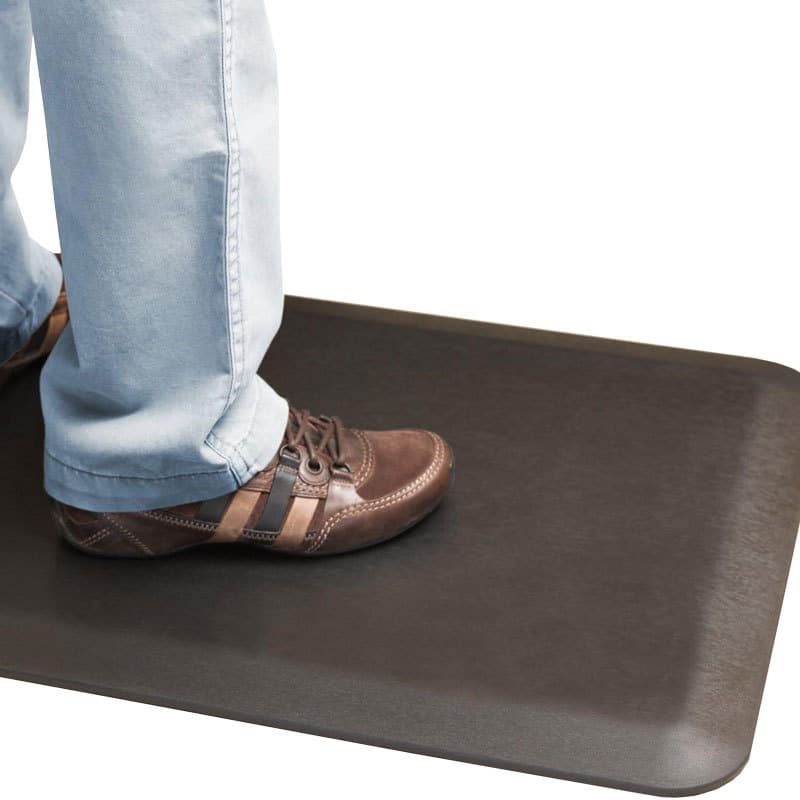
Walk along a production line and look down. You'll usually see the same thing: standard-size mats laid end to end, a gap where one stops short of a machine leg, an overlap where two were forced together, and a strip of tape holding a corner down. Each of those is a trip point, and each one exists because the mat was chosen from a size chart instead of the floor plan.
Industrial anti-fatigue mats work best when they're specified for the space. This guide is for operations managers, facility buyers and distributors who want to get that right the first time.
The short answer
To specify industrial anti-fatigue mats, measure each standing zone (including where people turn and step back), note equipment legs and walkways, then choose a size or custom shape that covers the whole zone in one piece. Pick density for shift length and floor type, insist on bevelled edges, and confirm everything on a sample first.
Step 1: Map the standing zones, not the workstation
A workstation drawing shows the bench. It doesn't show where the operator actually stands. Spend ten minutes watching a shift: people lean in, step back to reach a tote, turn to a second station, shuffle sideways along a conveyor. The mat has to cover all of that, or someone spends half the shift with one foot on concrete.
Then mark what's in the way. Machine legs, floor-mounted guards, cable runs, drains and forklift aisles all define where a mat can and can't go. A quick sketch with dimensions is enough; you don't need CAD drawings.
Step 2: Choose standard sizes or a custom shape
If the zone is a simple rectangle, a standard size is fine. Most lines aren't simple rectangles.
Our industrial anti-fatigue mat is made to the size and shape you specify, so it can run the full length of a line, sit as a single piece at one station, or wrap around equipment with cut-outs where legs and guards stand. One continuous mat has fewer edges than three standard mats butted together, and every edge you remove is one less place to catch a toe or a trolley wheel.
Send the sketch with dimensions. We confirm the shape during quotation and sampling, so you see it before the run.
Step 3: Set density and thickness for the shift and the floor
The mat is a cushioned PU foam core on a non-slip base, built with commercial-grade cushioning for 8-hour standing shifts. Within that, thickness and density are chosen per order.
Two things drive the choice. First, how long people stand in one place: an operator fixed at a station all shift needs firmer, more supportive foam than someone who moves between stations. Second, the floor underneath: bare concrete gives nothing back, so the mat has more work to do than on a raised or sprung floor.
Avoid the temptation to go as soft as possible. Very soft foam feels good in a five-minute trial and compresses flat by the end of a shift; a firmer core keeps supporting and recovers when the operator steps off. If you're unsure, trial two densities side by side at your busiest station. Our guide to anti-fatigue mat thickness explains how thickness and density work together.
Step 4: Edges, surface and cleaning
Bevelled edges are standard on our industrial mats: the edge tapers down to the floor so carts, pallet trucks and feet roll on and off instead of catching a step. On a line with wheeled traffic, ask for bevels on every side that faces a walkway.
The surface wipes clean. For design, there are options beyond a flat top: a contoured surface, or a version with raised massage balls for stations where operators want more stimulation underfoot. Try them at one station before rolling out; preferences vary a lot between teams.
Step 5: Check the environment honestly
PU foam mats suit dry production areas, assembly, packing, picking and service counters. Some environments need something else: heavy oil or coolant on the floor, standing water, or static-sensitive electronics assembly. If your line has any of these, say so at enquiry stage, and we'll tell you plainly whether this construction is right or not. A mat that fails in six months costs more than asking the question.
Step 6: Colour, logo and zoning
Colour and logo can be added to order. Beyond branding, colour is useful on the floor: a different colour for each cell or team, or a mat that marks the operator position at a shared station. If you run a 5S or visual-management programme, plan mat colours along with floor tape and signage.
Ordering and rollout
Start with one station. Send the sketch, how long operators stand, the floor type and any special conditions. We'll recommend thickness and density, confirm the shape and colour during quotation and sampling, and once the sample has been tested on your floor, the rest of the line can be ordered to the same spec.
See the industrial anti-fatigue mat, or for food-service lines, the solid-grip anti-fatigue kitchen mat. Ready to measure? Send us your layout.
FAQ
What should I consider when buying industrial anti-fatigue mats? How long people stand, the floor type, the shape of the standing zone, equipment and walkways around it, edge profile and cleaning. Then test a sample at your busiest station.
Can industrial anti-fatigue mats be made in custom shapes? Yes. Send the dimensions or a simple drawing of the work area, including cut-outs for machine legs, and the mat is made to that size and shape.
Are they suitable for 8-hour shifts? Yes. The PU foam cushioning is commercial grade and made for staff who stand through a full 8-hour shift.
Can you add our logo or colours? Yes. Colour and logo are confirmed during quotation and sampling.
This article is general industry guidance. For advice on a specific project, contact our team.
Related products