Logo Mats · 5 min read · October 9, 2026
Logo Mat Thickness: How to Choose Between 5mm, 6mm, 7mm and 9mm
Thicker isn't automatically better on a logo mat. Here's what logo mat thickness really measures, how pile height and backing add up, and which thickness suits which entrance.
Two quotes for the same logo mat, one says 6mm and one says 9mm. The thicker one must be better, right? Sometimes. Sometimes it's the mat that catches the bottom of your door every time someone walks in.
Logo mat thickness is a useful number, but only once you know what it's made of. Here's how to read it and choose.
The short answer
Choose by traffic, weather and door clearance. A thinner mat (5–6mm) suits covered entrances, indoor lobbies and doors with little clearance. A thicker mat (7–9mm) suits busy or exposed entrances that bring in more dirt and water, where a heavier mat also lies flatter. Always check the gap under the door first.
What logo mat thickness actually measures
Total thickness is the pile plus the rubber backing underneath it. Two mats with the same total can feel and work very differently, depending on how that thickness is split.
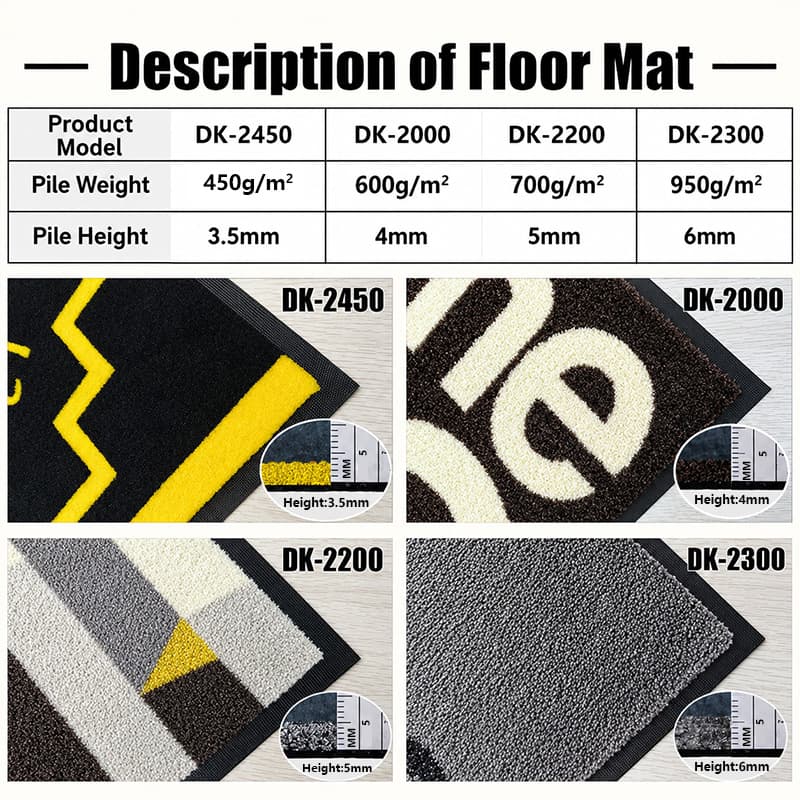
The pile is the nylon surface that takes the print, scrapes shoes and holds dirt and water. Across our printed logo mats, pile height runs from about 3.5mm up to 6mm, and the pile weight rises with it: roughly 450 g/m² at 3.5mm, 600 g/m² at 4mm, 700 g/m² at 5mm and 950 g/m² at 6mm. More pile means more yarn to trap dirt and soak up water, and a denser, richer-looking surface.
The backing is the rubber layer that keeps the mat flat and stops it sliding. It comes in standard or industrial grade, with a rubber border of around 15–20mm around the printed area. A heavier backing adds weight and helps the mat stay put at busy doors.
Total thickness options on our printed outdoor logo mat are 5, 6, 7 and 9mm. When you compare quotes, ask for pile height and pile weight as well as total thickness; that's where the real difference sits.
When thinner is the better choice
Doors are the first constraint. Measure the gap between the bottom of the door and the floor, with the door closed, before choosing a size. If a mat sits where the door swings over it, the mat has to fit under that gap with room to spare, or the door will drag on it and eventually ruck it up.
Thinner mats also suit covered entrances and interior lobbies, where they mostly catch dry grit rather than rain. They're lighter to lift, quicker to vacuum and easier to wash. For a store that rotates mats or sends them out for cleaning, that matters every week.
When thicker earns its place
At an exposed street entrance, a busy dealership door or anywhere that sees rain and snow, a thicker mat with more pile can hold more of what comes in on shoes before it reaches the floor inside. The extra weight helps too: a heavy mat lies flatter and stays where you put it, even with a constant stream of people.
If the mat sits outside the door rather than inside, door clearance usually stops being a limit, which is why outdoor positions are where the thickest options make most sense.
A quick way to decide
Use this as a starting point and adjust for your door and climate.
- Indoor lobby or covered entrance, light to moderate traffic: 5–6mm.
- Main customer entrance with steady traffic, door swings over the mat: the thickest option that clears the door.
- Exposed or high-traffic entrance, mat placed outside the door: 7–9mm with industrial-grade rubber.
- Mats on a laundering or rental cycle: ask about washable constructions; weight and handling matter as much as thickness.
Does thickness affect the logo?
A little. Print sits on the tips of the pile, so a denser, heavier pile gives a smoother, richer surface for the artwork. Very fine detail reads best on a dense pile. Colour is matched to your Pantone references either way, and you'll see it on a pre-production sample before bulk printing. For artwork tips, see our guide on preparing artwork for custom logo floor mats.
Don't forget the edges
On any thickness, the rubber border keeps the mat flat at the edges so it doesn't curl into a trip hazard. That matters more as mats get thicker. If your entrance has wheelchairs, trolleys or prams, mention it, and we'll advise on the edge treatment. Our article on non-slip backing for custom logo floor mats covers the grip side in more detail.
Ordering
Send your door width, the clearance under the door, whether the entrance is covered or exposed, and your logo. We'll recommend a thickness and confirm everything on a free digital proof. See the printed outdoor rubber logo mat or ask us for a recommendation.
FAQ
What thickness should a logo mat be? It depends on the entrance. 5–6mm suits covered entrances and doors with little clearance; 7–9mm suits busy or exposed entrances, especially where the mat sits outside the door.
Is a thicker logo mat better? Not always. Thicker mats with more pile hold more dirt and water and lie heavier, but they need door clearance and are heavier to handle and clean.
What's the difference between pile height and thickness? Pile height is the nylon surface only; total thickness adds the rubber backing. Ask for both, plus pile weight in g/m², when comparing quotes.
Will a thick mat stop my door from closing? It can, if the door swings over it. Measure the gap under the closed door before choosing the thickness.
This article is general industry guidance. For advice on a specific project, contact our team.
Related products