
Carpet Tiles · 7 min read · October 28, 2026
Carpet Tile Projects: What 8 Commercial Buyers Ordered and What We Learned
A school in Oman, a 15-hotel group in Canada, a spa in Thailand and a 5,689 m² high-rise in San Francisco all ordered carpet tiles, and no two specs were the same. Here's what eight commercial buyers ordered and what each project teaches.
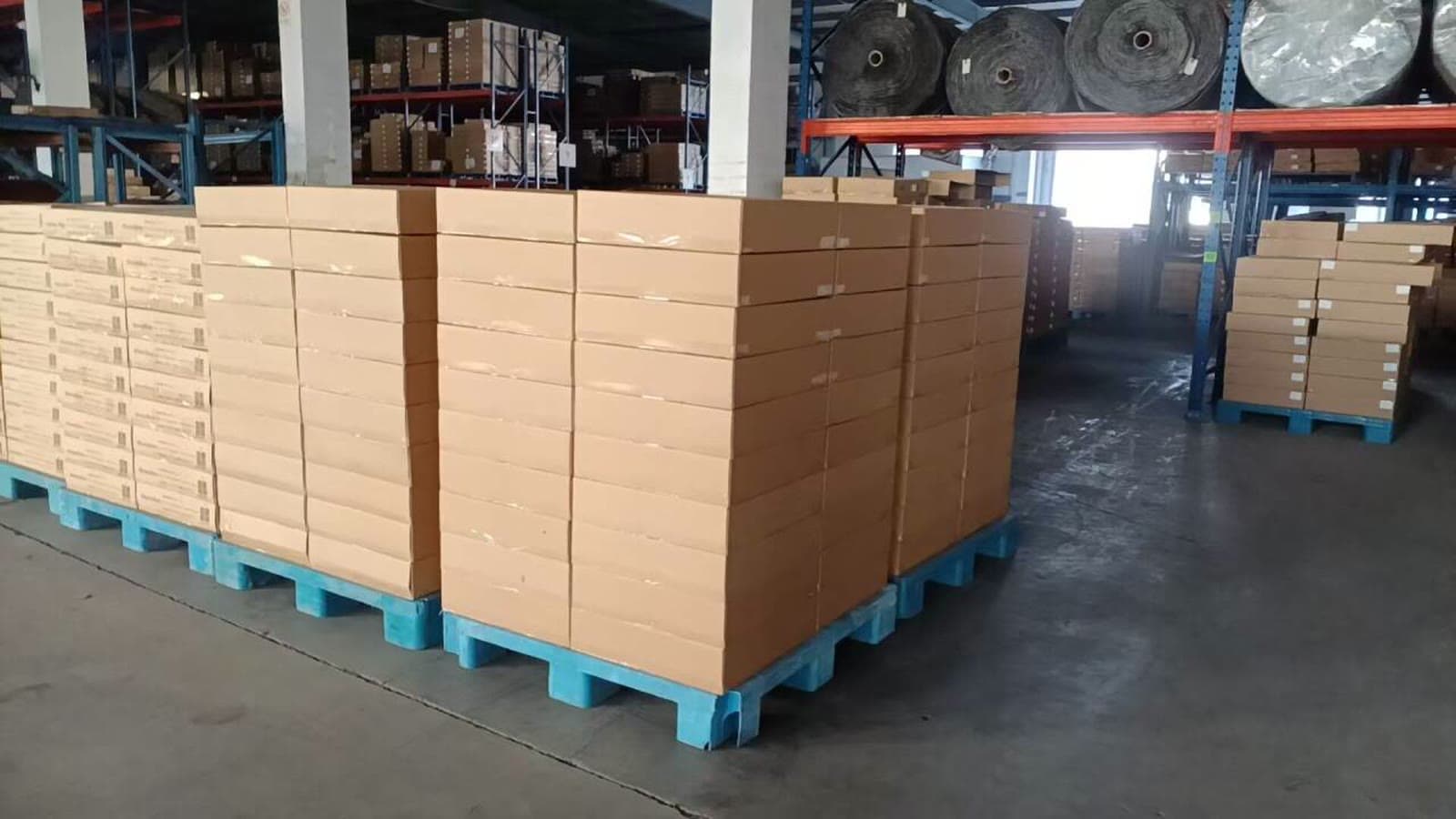
Spec sheets tell you what a carpet tile can be. Orders tell you what buyers actually choose. Between 2024 and 2025 we supplied carpet tiles for eight commercial projects across North America and Asia: offices, hotels, a school, a spa, a showroom, a convention centre and a high-rise.
This article goes through those carpet tile projects one by one: the space, the face fibre, the pile weight, the tile size and the quantity, plus the one decision that shaped each order. Client names and prices are left out; the specifications are real.
The short answer
Across eight commercial carpet tile projects, nylon on a PVC backing was the most common choice, at pile weights from 460 to 750 g/m². Polypropylene and flame-retardant polyester were chosen for a school and a spa where budget or the look mattered more. The 50×50cm tile was the most common size, and orders ran from 180 m² to 5,689 m².
The eight projects at a glance
Here are the eight carpet tile projects, with the specification each buyer ordered:
- Convention centre, Puerto Rico: nylon on PVC, 580 g/m², 1,045 m².
- Corporate office, Philippines: nylon on PVC, 4,400 g/m² total weight, 50×50cm, 588.5 m² (2,354 tiles).
- School, Oman: polypropylene on an embossed honeycomb non-woven backing, 6mm thick, 3 kg/m² total, 50×50cm, 1,000 m² (4,000 tiles).
- Office, United States: nylon on PVC at 1/12″ gauge, 460 g/m², 50×50cm, 750 m² (3,000 tiles).
- 15-hotel group, Canada: nylon on PVC, 550 g/m², 50×50cm, 630 m² (2,520 tiles).
- Spa, Thailand: flame-retardant polyester on a 3,200 g/m² PVC backing, 550 g/m², 33.33×100cm planks, 180.32 m² (541 planks).
- Electronics showroom, Canada: flame-retardant nylon on PVC, 750 g/m², 50×100cm, 418 m² (836 tiles).
- High-rise building, San Francisco, for an Australian property investor: custom and stock nylon designs at 550 and 650 g/m², 50×50cm, 5,689 m².
Offices: neutral colours, a sample before shipping
The two office projects show what most corporate buyers want from carpet tiles: a hard-wearing nylon tile in a colour nobody will notice in five years. The United States buyer asked for a catalogue and a quote for about 700 m² of nylon tiles and described the colour as neutral, greyish, with some highlights. The order became 750 m² of 460 g/m² nylon on PVC at a fine 1/12″ gauge.
The Philippines office added one step that every office buyer can copy. When production finished, one full-size tile from the bulk run was sent to the buyer first, and the goods shipped only after the buyer approved it. That single tile catches a colour or construction problem while it can still be fixed; our guide to samples and digital proofs covers the full approval process.
Hotels: a buyer worried about Canadian winters
A Canadian hotel group buying for 15 properties had one question before it ordered: would the tile stand up to a severe, snowy winter, with guests walking in from salted pavements? The deciding factor wasn't a test certificate. Another Canadian hotel customer had already bought the same nylon tile, and that reference closed the order.
The group ordered 630 m² of 550 g/m² nylon on PVC in 50×50cm tiles. For a hotel corridor, nylon at a mid-range pile weight is the usual balance of wear and cost; our guide to commercial carpet tiles by space type explains how to match the tile to the room.
A school: polypropylene, a strong backing and a deadline
The school in Oman is the clearest budget-led project of the eight. The buyer chose a multi-colour polypropylene tile on an embossed honeycomb non-woven backing, 6mm thick and about 3 kg per square metre, for 1,000 m² (4,000 tiles of 50×50cm). Polypropylene costs less than nylon, which suits a large floor where budget leads the specification.
The order was urgent, so packing was agreed up front: plain brown cartons of 22 tiles (5.5 m²) each, taped and reinforced at the top and bottom. Agreeing the carton spec before production means the forwarder can plan the load before the goods are ready.
A spa: planks instead of squares
The Thai spa didn't want a square grid. It ordered 33.33×100cm planks in flame-retardant polyester, 550 g/m², on a heavy 3,200 g/m² PVC backing, for 180.32 m² (541 planks). Planks laid in an offset or herringbone pattern read more like timber than office carpet, which suits a calm treatment space; see carpet tile sizes and installation patterns.
The spa order is also a reminder that small projects are possible. At 180 m², it was the smallest of the eight.
A showroom: gold, because everything else was black
The Canadian electronics showroom had a problem a spec sheet would never mention. The kiosks, the ceiling, the curtains and the old carpet were all black, so the kiosks disappeared on camera. The buyer wanted a gold-toned carpet so the kiosks would stand out in person and on video, and asked specifically for a high pile weight.
The order was 418 m² of 750 g/m² flame-retardant nylon on PVC in 50×100cm tiles, the heaviest construction of the eight projects. When a floor is part of a brand or product display, colour and pile weight are design decisions as much as wear decisions.
A convention centre and a high-rise: matching what's already there
The Puerto Rico convention centre asked for a good commercial-grade tile, explicitly not the cheapest one, for heavy foot traffic, with stain resistance, easy maintenance and durability. Three samples were sent: one close to the existing grey carpet and two more modern options. The buyer chose an ombre blue and ordered 1,045 m² of 580 g/m² nylon on PVC.
The largest project, 5,689 m² for a high-rise in San Francisco, started with the buyer posting us a sample of the carpet they wanted to match. The tiles were sampled against it in two rounds before production, in custom and stock nylon designs at 550 and 650 g/m². On a building that size, a few rounds of sampling cost far less than a floor that doesn't match.
What these carpet tile projects have in common
Eight different spaces, but the same handful of decisions came up in every order:
- Nylon on PVC is the default commercial choice; polypropylene and polyester come in when budget or appearance leads.
- Pile weight follows the space: 460 g/m² for an office, 550–650 g/m² for hotels and buildings, 750 g/m² for a showroom.
- 50×50cm is the most common size, but planks (50×100cm and 33.33×100cm) were ordered for a spa and a showroom.
- Samples decide the colour: three options for the convention centre, two rounds for the high-rise, a bulk tile for the office.
- The purchase order sets the quality terms. These orders allowed ±2% on quantity, ±2% on size and ±5% on weight, and named colour difference, poor bonding and undersized tiles as failures.
How to order
Send the floor area in m², the type of space, the face fibre and pile weight you have in mind, the tile size, any fire rating your market requires and your destination port. If you're matching an existing floor, send a sample or photos. Our guides to buying wholesale carpet tiles and carpet tile test reports cover the checks before a bulk order. See the carpet tile range or send us your project details.
FAQ
What carpet tiles do offices usually order? The offices in these projects ordered nylon carpet tiles on a PVC backing at 460 g/m² and above, in 50×50cm tiles and neutral colours.
Are polypropylene carpet tiles suitable for schools? Yes. A school in Oman ordered 1,000 m² of polypropylene tiles on a non-woven backing, a lower-cost construction that suits large floors where budget leads.
Can carpet tiles be made as planks? Yes. These projects included 50×100cm tiles for a showroom and 33.33×100cm planks for a spa.
What is the smallest carpet tile order in these projects? The smallest order was 180.32 m² of polyester planks for a spa in Thailand; the largest was 5,689 m² for a high-rise in San Francisco.
This article is general industry guidance. For advice on a specific project, contact our team.
Related products