
Carpet Tiles · 6 min read · October 27, 2026
How Carpet Tiles Are Made: Tufting, Pre-Coat, Backing, Cutting and Packing
A carpet tile feels like one solid piece, but it's built in layers on a production line. Here's how carpet tiles are made in six steps, and what each step changes about the tiles that arrive on your project.
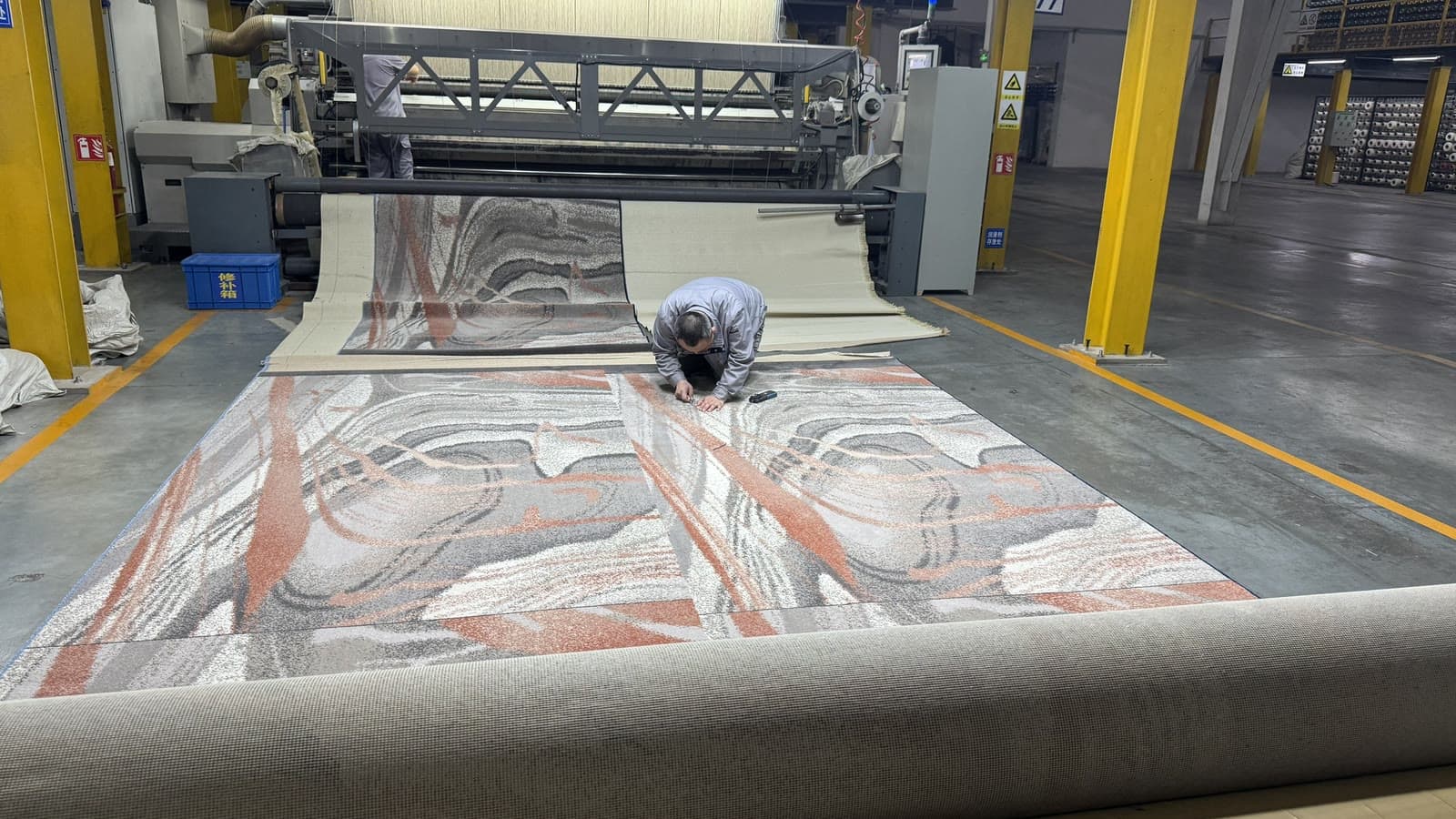
Pick up a 50×50cm carpet tile and it feels like one solid piece. It isn't. A carpet tile is yarn tufted through a backing cloth, a pre-coat that locks that yarn in, and a heavy backing layer underneath, all built on one production line and then cut to size.
This guide is for contractors, distributors and project buyers who order carpet tiles by the pallet. It explains how carpet tiles are made, step by step, and what each step decides about the tiles you'll lay: how firmly the pile holds, whether the tiles lie flat, and how cleanly the edges meet.
The short answer
Carpet tiles are made in six steps. Yarn is tufted into a primary backing cloth; a pre-coat slurry is spread on the back to lock the tufts; a secondary backing such as PVC, bitumen or felt is laminated underneath; the composite is cooled so it sets flat; the wide sheet is cut into tiles; and the tiles are boxed and palletised.
Step 1: Tufting the carpet face
Tufting makes the face of the tile. A row of needles pushes yarn through a primary backing cloth, usually a non-woven spunbonded polyester, and forms loops. Leave the loops intact and you get loop pile; cut them and you get cut pile. The yarn feeds in from a creel, a wall of cones with one cone for each needle.
Most of the specification is fixed at this step: the face fibre, the pile weight, the pile height and the gauge (the distance between needles). One nylon carpet tile in our range, for example, is a tufted level loop in 100% solution-dyed nylon BCF, with a 4.0 ±0.5mm pile height at 1/10″ gauge.
The face fibre is the biggest lever on budget. Carpet tile faces are made in nylon, polypropylene (PP) or polyester, and pile weights across the ranges we quote run from about 400 to 900 g/m². When you compare quotes, compare g/m² and fibre, not photos; our guide to buying wholesale carpet tiles explains why.
Step 2: Pre-applied slurry locks the tufts
A freshly tufted face is held in the cloth by friction alone. Pull a loop and it slides out. So the back of the cloth gets a pre-coat: a liquid slurry spread evenly across the back, which soaks around the base of every tuft and sets.
The pre-coat is what decides tuft bind, the force needed to pull one tuft out of a tile. Tuft bind matters most under office chairs and in corridors, where castors and heels pull at the pile all day. A tuft pull-out test checks it, and our article on carpet tile test reports explains how to read the result.
Step 3: Backing composite gives the tile its weight
The secondary backing is laminated under the pre-coated face. The backing gives a carpet tile its weight and stiffness, and that weight is why a carpet tile lies flat and stays in place on the floor. Carpet tile backings come in several materials:
- PVC: the backing on most of the project orders in our case files, from offices to hotel groups.
- Bitumen (pitch): a heavy, traditional backing.
- Felt, thin or thick: a polyester felt that adds cushioning underfoot.
- PU, TPE and PE: other backings used on specific ranges. PE gives adhesive a poor grip, so a PE-backed tile needs an adhesive chosen for it.
Some constructions add a glass-fibre layer inside the backing. The glass fibre keeps the tile from stretching or shrinking, so the tiles still meet edge to edge after months on a floor that warms up and cools down.
Step 4: Cooling and setting
The backing goes on hot. If the composite were cut while it was still warm, the tiles would curl at the corners or dome in the middle. So the sheet runs over cooling rollers and sets completely flat before it reaches the cutter.
You can't see this step in a finished tile, but you can see when it went wrong: a tile that rocks on a flat floor, or corners that lift after a week. Dimensional stability tests measure how much a tile moves after it gets wet and dries again.
Step 5: Precise cutting into tiles
A cutting press stamps the wide sheet into tiles. The standard carpet tile sizes are 50×50cm, 25×100cm and 60×60cm (sold as 61×61cm in some markets). Custom sizes are possible, but they work best in multiples of 25cm, for two reasons.
The first reason is machine width. Sizes that divide neatly into the width of the sheet waste less material. The second reason is the pattern. A design drawn across four 25×100cm planks repeats every 100cm. Cut that same sheet into 60×60cm tiles and three tiles cover 180cm, so the next tile starts 20cm into a new repeat and the pattern no longer lines up.
Custom sizes and tip shearing (trimming the pile surface for texture) can carry a surcharge, confirmed in the quote. For laying patterns once the tiles are cut, see carpet tile sizes and installation patterns.
Step 6: Packaging and storage
Finished tiles are counted into cartons, sealed and stacked on pallets. A typical carpet tile packing spec is 5 m² per carton (20 tiles of 50×50cm), 28 cartons or 140 m² per pallet for part loads, and 56 cartons or 280 m² per pallet for full containers, on pallets about 1.1×1.1×2.2m.
Ask for the production batch to be marked on the carton labels. Keep the cartons from one dye lot together on site, and keep a few spare tiles from the same lot; our guide to carpet tile maintenance and replacement explains why.
What this means for your order
Each production step maps to a line in your purchase order. Tufting sets the fibre, pile weight, pile height and gauge. The pre-coat sets tuft bind. The backing sets weight, cushioning and which adhesive you need. Cutting sets the size and the pattern repeat. Packing sets how many square metres arrive on each pallet.
Write all of these down before production, and ask for a sample from the same construction. A physical sample shows the pile, the backing and the edge cut in a way a spec sheet can't; see samples and digital proofs.
How to order
Send the floor area in m², the type of space, the face fibre and backing you prefer, the tile size, any fire rating your market requires and the destination port. MOQ depends on the range: some stock patterns can be ordered from 1 m², while standard production ranges start at around 300–500 m². See the modular office carpet tile, the full carpet tile range, or send us your project details.
FAQ
How are carpet tiles made? Carpet tiles are made by tufting yarn into a backing cloth, locking the tufts with a pre-coat, laminating a backing such as PVC or bitumen underneath, cooling the sheet flat, cutting it into tiles and packing the tiles into cartons.
What is the backing of a carpet tile made of? Carpet tile backings are made of PVC, bitumen, polyester felt, PU, TPE or PE. Some backings include a glass-fibre layer for dimensional stability.
Why are carpet tile sizes multiples of 25cm? Sizes in multiples of 25cm waste less of the sheet's width and keep a printed or tufted pattern lined up from tile to tile.
How many carpet tiles are in a carton? A typical carton holds 5 m², which is 20 tiles of 50×50cm.
This article is general industry guidance. For advice on a specific project, contact our team.
Related products